

What became of my robotics predictions from 2018—and why I am bringing a few old slides to Industrie Digital 2026 in Hannover.
Some invitations take years to reveal their full significance. When my speaking agency booked me for a keynote at Herrenhausen Palace in 2018, it initially meant another date in the diary. An exceptionally beautiful venue, a conference with a distinguished line-up, and a subject I enjoyed talking about: how will we live with robots? It turned into a wonderful day, one I also remember for its many stimulating conversations. Returning almost eight years later with the same slides, to be held to account for them, was not part of that presentation.
The idea emerged when the organisers invited me back. Roughly ten years had passed, they suggested; it would be interesting to see what had become of those predictions. In fact, the two appearances are just under eight years apart. The generous rounding seems appropriate to the subject. Discussions about technology tend to take liberties with time: a research breakthrough becomes an everyday reality supposedly just around the corner; a difficult integration project becomes evidence that nothing has really changed.
The intervening years are easier to detect in me. There is more grey in my hair, and the beard has changed too. The predictions warrant a closer look.
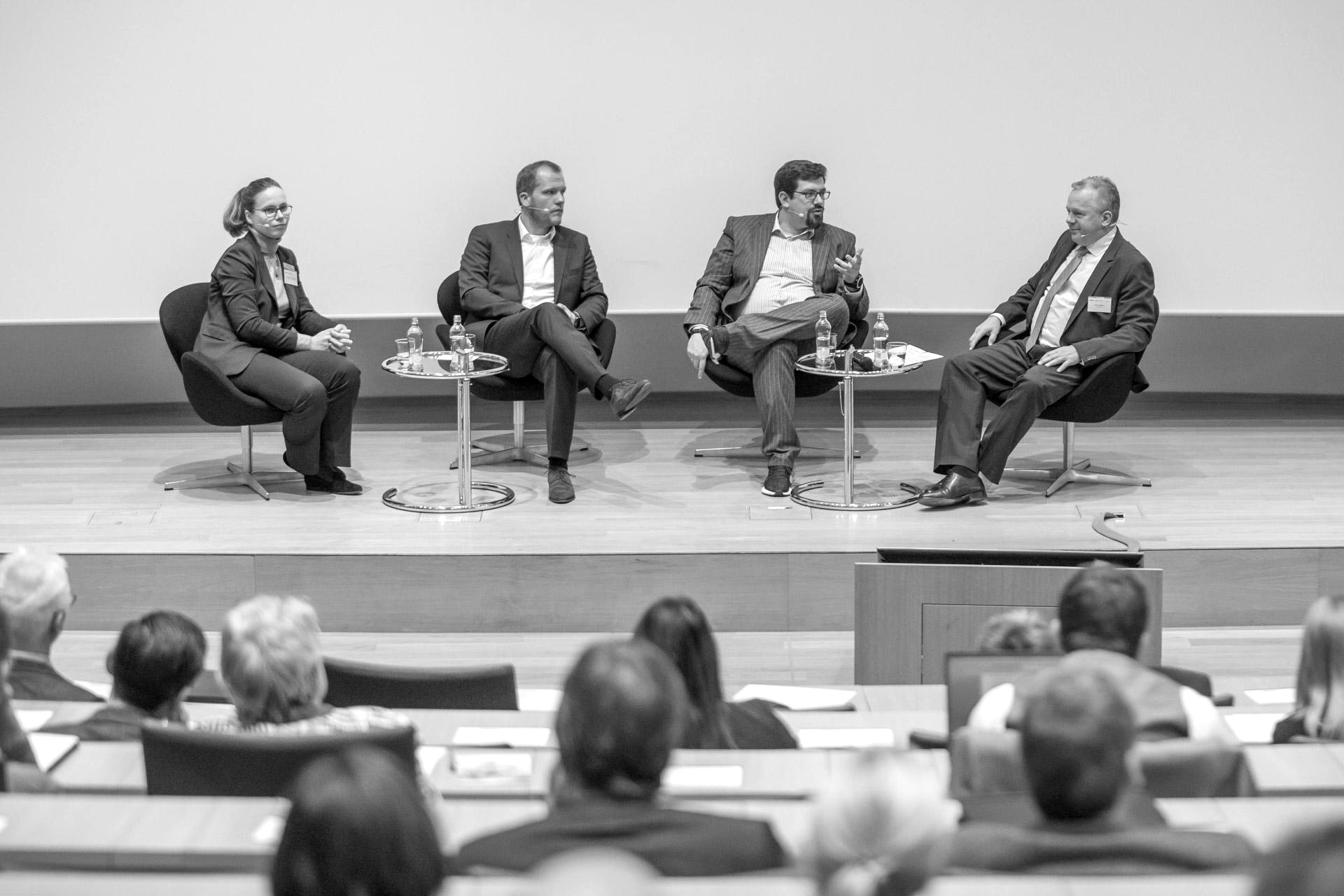
The occasion for this return On 22 November 2018, I spoke about life as “Robotic Natives” at the Industrie 4.0 conference organised by NiedersachsenMetall, held at Herrenhausen Palace in Hannover, Germany. On 11 November 2026, I return to the same venue for Industrie Digital, a conference exploring the possibilities of AI and robotics for industry. My contribution revisits selected claims from that earlier talk and asks how well they stand up today. This article was written ahead of the event. 2018 programme · Industrie Digital 2026
The old slides open with fortune sticks, tarot cards and molten-lead divination. This was not a departure from engineering. It was a small reminder of how seductive it is to assume the role of someone who knows the future. Speaking about what lies ahead comes with a convenient advantage: the audience cannot yet check whether you are right.
After the oracles came megatrend research. There is a useful distinction here. We can make different kinds of statements about a population’s development and about the next technological breakthrough. Age groups move through the statistics with a degree of predictability. When a new idea will leave the laboratory, become economically viable and spread into everyday use depends on far more unknowns. Decisions, investment, regulation and often inconspicuous technical prerequisites all intervene.
A retrospective needs to recover those distinctions. Had I described a direction? Named a date? Confused a possibility with an expectation? A talk that was well received particularly deserves this second reading. Applause is gratifying, but a rather unreliable measure of a forecast’s quality.
In 2018, the case I made for greater automation was largely demographic. As societies age and fewer people enter working age, the question of how to sustain prosperity, essential services and industrial capacity becomes more pressing. One slide therefore put it plainly: we need automation.
Alongside that argument, however, was a number that deserves correcting. A McKinsey study I cited projected that half of Germany’s population would be over 50 by 2020. In fact, the annual average was approximately 44.8 per cent aged 50 or above. Even including people who were exactly 50 leaves a substantial gap. The ageing of society had been correctly identified; the specific figure was wrong. An honest retrospective has to accommodate both findings. McKinsey study · Population data from Germany’s Federal Health Reporting system
That error did little to alter the underlying challenge. In three projection variants with different migration assumptions, Germany’s Federal Statistical Office expects 3.2 million to 4.9 million fewer people aged 20 to 66 in 2035 than in 2024. These are not forecasts of unfilled jobs. The labour available also depends on participation, working hours, qualifications and productivity. Nor is the whole world ageing at the same pace: the United Nations describes markedly different demographic trajectories across countries. Destatis on population development · UN World Population Prospects 2024
For ageing economies, I consider my conclusion from 2018 more urgent today. We will need to be more deliberate about how we use people’s working time. An automated material-handling system that saves skilled staff unnecessary journeys presents a different calculation from simply striking labour costs off a slide. Part of its value lies in putting experience to work where it is needed. That, of course, assumes the transport system actually works and the time it releases can be put to good use.
Demography operates over decades. Investment decisions are often deferred until the next quarter. Much of the pressure to act today arises from this mismatch in time horizons.
The Four Robotic Revolutions, which Bernd Liepert and I published in 2016, provided another framework for the talk. The model describes an expansion of robotic capabilities: from conventional industrial automation through force-sensitive, safe systems and mobile robotics to cognitive capabilities that allow machines to perceive their surroundings and adapt their actions accordingly. These developments overlap. A proven robot cell does not cease to be useful because a humanoid robot somewhere else can climb stairs. The original Four Robotic Revolutions paper
I still find this map useful. Its strength is that it makes different technical prerequisites visible. It was never a calendar of fixed delivery dates, even in 2018. My slides already treated mobile robotics as a present reality and identified software and AI as the key to further development.
What I underestimated was the speed at which AI itself would advance. Research such as Gemini Robotics 1.5 now shows how models can combine language instructions, visual perception and robotic action. A task with several parts can be broken down into steps and carried out by a robot. That is a substantial advance over a machine that has to be laboriously instructed in every individual movement. The findings remain specific to the systems, tasks and experimental conditions studied. Gemini Robotics 1.5 research report
Some hardware developments also moved faster than I expected. Humanoid systems are now offered in quantities I once thought would be difficult to achieve. The International Federation of Robotics puts worldwide sales of humanoid robots taller than 1.4 metres at approximately 7,000 units in 2025. A unit count, however, says little about how independently these machines work or how many tasks they can perform reliably. IFR on humanoid robots
This brings back an observation from my time at KUKA. When I was working on consumer robotics, I liked to point to toy manufacturers. Anyone who can build an affordable plastic water pistol or dart blaster that survives being handled by teenagers knows something about design, materials and manufacturing. Nerf and Super Soaker were my examples: there might be lessons there for robust, affordable consumer robots. A machine’s future is sometimes decided by less glamorous matters than its face.
What has been demonstrated?
Task · Conditions · Limits
How reliably does it work under real-world conditions?
Failures · Interventions · Safety
How many use it cost-effectively?
Application · Costs · Lasting value
More capable AI and more readily available hardware change what is possible. Once deployed, they encounter a world reluctant to conform to the conditions of a demonstration. Workpieces vary, processes change, interfaces do not fit, and people have to intervene. Some software errors can be dealt with by resetting the system. A robot may already have dropped a component.
That is why the comparatively quiet success of mobile systems interests me at least as much as the next spectacular humanoid video. For 2025, the IFR’s manufacturer sample records approximately 117,500 service robots sold for transport and logistics. This is an important application category, rather than a complete count of all robots worldwide. Such tasks offer a useful way to study how automation establishes itself in everyday operations. IFR statistics and survey methodology
If vehicles from different manufacturers are to work together in the same facility, they need, among other things, a common language for communicating with the fleet controller. The VDA 5050 interface enables them to exchange orders and status information. It sounds less futuristic than a humanoid robot. For an operator, this unremarkable exchange may determine whether a fleet can be managed reliably over time. VDA 5050
There are also serious humanoid pilot applications. BMW reports that Figure 02 moved more than 90,000 components in Spartanburg during 2025. The robot picked and positioned sheet-metal parts for a welding process. This provides firmer ground for discussion than a demonstration alone. BMW on the Spartanburg pilot
If another manufacturer wanted to transfer that approach to its own line, I would start the calculation afresh. What variants occur? What cycle time is required? What happens if two sheets stick together? How quickly can production resume after a fault? Success in one application is valuable evidence. The operating conditions of the next still need to be understood.
Gartner, too, distinguishes technical fascination from adoption. Its 2024 Hype Cycle for mobile robotics in supply chains placed broad humanoid adoption ten years or more away. Its public assessment of Physical AI in 2026 emphasises how perception, planning, safety and integration must work together. These are analysts’ assessments made at particular points in time. They cannot guarantee when an individual project will succeed. Gartner on logistics, 2024 · Gartner on Physical AI, 2026
My assessment today therefore varies by the question being asked. Progress in robotics has been considerable. In my view, the great leap to systems that reliably perform a wide range of tasks under changing conditions throughout everyday life still lies ahead. Taking that distance seriously allows for enthusiasm without requiring us to believe every promised deadline.
My 2018 slides contain neither the specific COVID-19 pandemic nor the Ever Given, which became stuck in the Suez Canal in 2021. Both events changed the economic conditions in which businesses were making decisions about their future. Yet it would be too easy to label them entirely unforeseeable “black swans” after the fact. Warnings about a severe respiratory pandemic predated COVID-19. Recognising that a risk exists and predicting exactly when it will materialise are very different achievements. WHO on pandemic preparedness · UNCTAD on the Suez blockage
This is where scenarios earn their place. A company does not need to know the name of a ship that will later run aground to examine its dependence on a shipping route. It can ask what would happen if a supplier failed, or which activities would need to continue with substantially fewer staff. Such exercises do not make the future predictable. They create more room to act when events unfold differently from expectations.
Looking back at 2018 has therefore also sharpened my understanding of foresight. A good forecast should help improve decisions. Anyone interested only in the most impressive prediction that came true can easily overlook preparation that remains useful even when a particular event never happens.
One old question has aged particularly well: what problem is a technology supposed to solve? Even my Industry 4.0 slides asked about value for the customer. Today, I pursue this idea through Use Case Driven Robotics and my work at the Center for Robotics.
It involves a demanding sequence. First, we describe the task and the conditions a good solution would have to meet. Then we choose the technology. Sometimes that calls for robots capable of learning. Sometimes a better feeder, a different organisation of work or a conventional robot arm will help. People who fall in love with a particular machine too early can become remarkably inventive at finding a problem for it afterwards. I certainly do not exempt my own enthusiasm for technology from that temptation.
I also remain convinced by the idea of Generation R: children and grandchildren for whom interacting with robots may become entirely ordinary. Today, I would explicitly include AI. In my notes from 2018, I considered a universal robot butler by 2025 premature; 2040 appeared as a possibility. Perhaps the more interesting question now is which individual tasks will pass to machines long before such an all-rounder arrives—and what people will need to learn in order to have a say in that transition.
For this generation, being able to exercise informed judgement about technology will have very practical consequences. They will need to assess when a machine can be trusted, how to recognise its limits and who bears responsibility. The more a system can do, the more carefully we should be able to explain what we use it for.
So I am taking a few old slides and some more precise questions back to Hannover. Where was I right? Where was I too cautious? Where was a number simply wrong? In future robotics forecasts, I want to specify more carefully which tasks a system should be able to perform, under what conditions and with how much human assistance. That would make the next reunion more rewarding, too.
The future rarely follows our calendar. We can still hold it to certain expectations: that technical possibilities become dependable tools, and that people gain greater scope to act. There are a few more grey hairs now. A few questions can remain open.
Further reading: AI, skills and the future of work, robotics in practice at EDAY and responsibility for autonomous machines.
Some advances are already usable; others remain laboratory results or pilots. This selection includes both. Each date marks a demonstration, publication or authorisation, rather than the invention of an entire field. Expand each entry for its explanation, limitations and source.
AlphaFold 2 achieves a major improvement in protein-structure prediction at CASP14. The method and code are released in 2021, making AI a practical tool for structural biology.
Perspective: A predicted structure does not automatically explain a protein’s full function or replace every experiment.
EU authorisation of Comirnaty makes an mRNA vaccine against COVID-19 available for vaccination programmes. A technology developed over many years crosses into large-scale medical use.
Perspective: Authorisation concerns a specific product and indication, not a universal vaccine.
NASA’s Ingenuity completes the first powered, controlled flight on another planet. Its onboard systems fly autonomously: it cannot be piloted from Earth with a joystick.
Perspective: A highly specialised autonomous task, not evidence of general machine intelligence.
ChatGPT launches as a public research preview. People can give a language model instructions in everyday language and ask follow-up questions, lowering the barrier to using generative AI.
Perspective: Fluent answers can be incorrect. The launch does not establish AGI.
A National Ignition Facility experiment releases more fusion energy than the laser energy delivered to its target. This is a physics milestone on the path towards fusion energy.
Perspective: Total facility energy input remains higher; this does not demonstrate a net-energy-producing power station.
The UK medicines regulator authorises Casgevy, the first licensed medicine using CRISPR. The treatment edits a patient’s own stem cells for specific severe blood disorders.
Perspective: A complex specialist treatment, not a universal way to correct genetic diseases.
Google’s Willow processor demonstrates quantum error correction below a critical threshold. Larger protected quantum memories achieve lower logical error rates, a prerequisite for more reliable quantum computers.
Perspective: Not a universal commercial quantum computer or proof of superiority on everyday tasks.
Gemini Robotics combines visual and language processing with robot actions. Research demonstrations show systems responding to spoken instructions and changing situations.
Perspective: The demonstrations do not establish universal reliability across workplaces or homes.
BMW reports a ten-month Figure 02 pilot in Spartanburg. The robot handles more than 90,000 sheet-metal parts for welding, a concrete industrial application with a narrowly defined task.
Perspective: A company report about one application, not proof of general readiness or widespread economic viability.
Version 3.0 of VDA 5050 extends open communication between mobile robots and fleet control. Zones and shared route information support freely navigating robots in mixed fleets.
Perspective: An interface supports integration; it does not automatically guarantee compatibility or system safety.
Mobile robotics, AI-based perception and the connection between language models and robotic action have advanced. Humanoid hardware is also available in larger quantities. Readiness for deployment nevertheless depends on the specific task. A specialised transport robot, an industrial humanoid pilot and a research model capable of different actions demonstrate different kinds of progress. They should not be collapsed into a single claim about “robotics”. IFR · Gemini Robotics 1.5
The model that Bernd Liepert and I published in 2016 describes four developments: conventional industrial automation, force-sensitive and safe systems, mobile robotics, and cognitive capabilities. These capabilities can overlap and combine. The model helps organise technical prerequisites and development paths; it does not prescribe universal adoption dates. Original paper
As fewer people enter working age, ageing economies face greater pressure to improve productivity. Automation can take over recurring tasks and ease the burden on skilled staff. It is one possible response alongside higher labour-force participation, training and other measures. A population projection does not, by itself, predict a particular number of unfilled jobs. The relevant questions are which activities lack capacity and how a concrete solution improves the ability to work and deliver essential goods and services. Destatis
There is no reliable single date. Individual pilots are already documented, such as Figure 02 at BMW in Spartanburg. Broad adoption depends on factors including reliability, cost, safety, maintenance and integration into existing processes. Gartner’s 2024 assessment placed broad adoption in supply chains ten years or more away. This was an analyst forecast at the time, rather than a universal technical deadline. BMW pilot · Gartner 2024
Use Case Driven Robotics starts with a concrete task: what should work better, what constraints apply, and how will success be measured? The choice of robotics, software and workflow follows from those questions. In my work, this is a guiding idea for connecting enthusiasm about technology with demonstrable value. A humanoid body is one possible design, rather than a choice made in advance.
A demo can show that a particular action is possible under particular conditions. Dependable operation must also handle variation, faults, maintenance and responsibilities. For a specific task, the requirements should therefore describe factors such as variants, cycle times, permitted interventions and recovery time after a fault. These criteria make progress testable and help compare different solutions fairly.
By Generation R, I mean a generation growing up with robotics as naturally as earlier generations grew up with computers. Today, I explicitly include AI. This is not a statistically defined age cohort, nor a guarantee that every child will have a humanoid robot at home. It describes a changing everyday life that calls for technical judgement, an understanding of limitations and a voice in how society uses these technologies.
I would distinguish more clearly between direction, speed and adoption. In 2018, I had explicitly identified the role of software and AI; I underestimated the pace of development in AI and humanoid hardware. The demographic figure of 50 per cent was too high. At the same time, integrating technology into safe and economically viable operations remains demanding. A forecast today should therefore say more precisely which capability, application and form of adoption it refers to.
New public dates will be announced here. Explore past appearances and selected resources in the archive.
Hannover · Schloss Herrenhausen
Vienna/Vösendorf, Austria · Eventhotel Pyramide
Vienna · Vienna International Centre (VIC)
Helsinki, Finland · Clarion Hotel Helsinki
Munich · Design Offices München Atlas
Gütersloh
New York
Dominik Bösl
Olympiastrasse 6a
DE-86179 Augsburg
Email info@boesl.org
Imprint Privacy Policy ©2026 | Dominik Bösl. All rights reserved.