After Hannover: What Robotics Must Deliver Over the Next Ten Years

After Hannover: What Robotics Must Deliver Over the Next Ten Years

INDUSTRIE DIGITAL 2026 brought the future of robotics into practical focus: how do technical capabilities become dependable applications, better work and economic value? My reflections on the event, with a personal outlook to 2036.

A shoelace is a surprisingly good test of how we imagine the future. When a robot ties one, we see a remarkable technical achievement. In our minds, the next steps can follow almost automatically: surely the machine could also fold a shirt, process a returned item or run a household. Much of the work we discussed in Hannover lies between those propositions.

On 11 November 2026, I joined INDUSTRIE DIGITAL at Schloss Herrenhausen. NiedersachsenMetall, Lower Saxony's Ministry for Economic Affairs and Niedersachsen.next had organised the congress around the question “ROBOTICS! How will industry work in 2030?” For me, it became a day of different perspectives and a welcome shared willingness to examine the details before settling on a vision of the future.

Before returning, I had reviewed my robotics predictions from 2018. This second article starts with this year's conversations and asks what we can learn for the next decade.

The organiser's report focuses on productivity and industrial competitiveness. Our discussions raised further questions: who controls the relevant data? How do employees learn to work with new systems? How do we test applications responsibly? And how do we explain the choices that society should be able to debate?
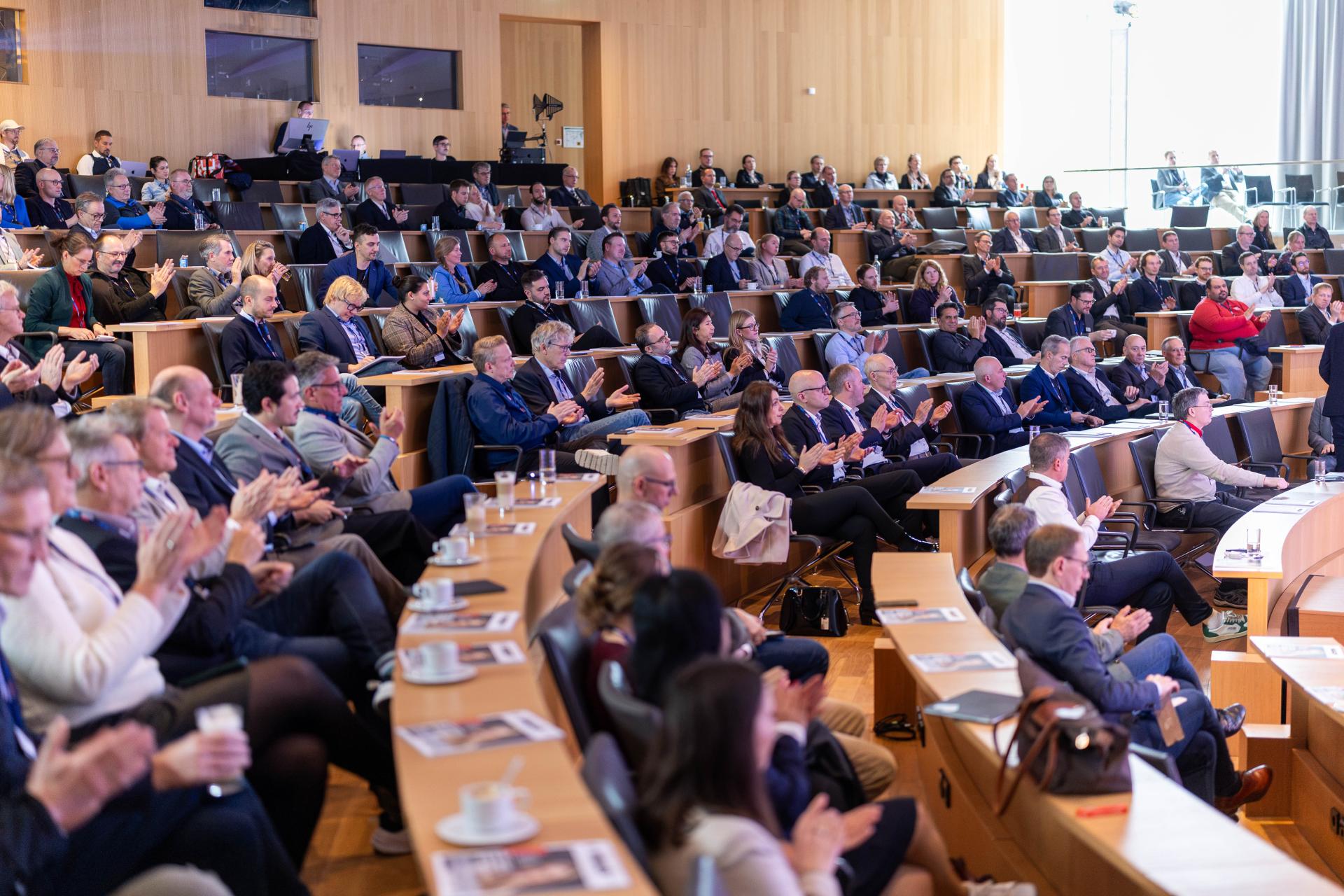
Audience seated in the conference hall at INDUSTRIE DIGITAL 2026 in Hannover.
The audience at Schloss Herrenhausen: perspectives from industry, research and politics. Photo credit: Florian Arp / NiedersachsenMetall.

Good dialogue makes room for disagreement

Philipp Klöckner's “Beyond the AI Hype” provided plenty to think about. I found his connections between AI development, economic conditions and industrial software capabilities interesting. In robotics, our assessments diverged at a particular point: how far can success in one manipulation task support expectations about other tasks involving deformable objects?

A fair account must acknowledge the qualifications Klöckner made himself. His presentation explicitly distinguished announced production capacity from robots actually delivered. My concern is the transferability of a demonstrated capability. That is a useful place for technical disagreement, because an expectation can eventually become an investment decision.

The moderation made room for such differences. I considered that a strength of the event: varied voices, constructive disagreement and an audience willing to engage with a realistic assessment. Interest in robotics and Physical AI was substantial, as was the desire to understand the conditions for useful deployment.

I also welcomed the call to action I took from Economic Affairs Minister Grant Hendrik Tonne's contribution. The official ministry release links robotics to benefits for employees and companies, knowledge transfer and suitable conditions for innovation. My practical conclusion is to begin, gather experience and use it to improve the next decision.
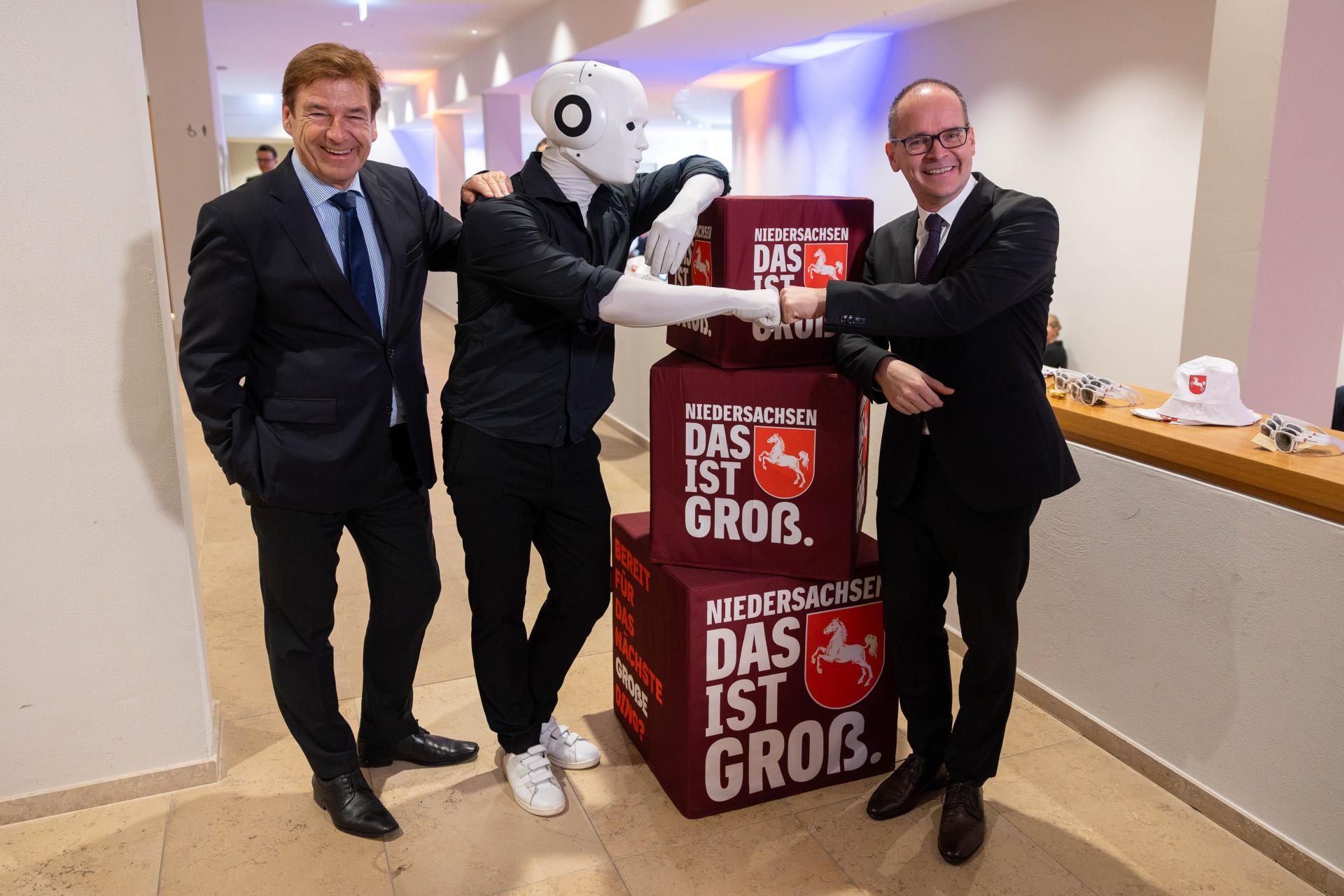
Volker Schmidt on the left and Grant Hendrik Tonne on the right beside a person wearing a robot costume.
Volker Schmidt (left) and Grant Hendrik Tonne (right) with a “humanoid” — in this case, a person wearing a robot costume. Photo credit: Florian Arp / NiedersachsenMetall.

Three numbers and the question behind them

The IFR's World Robotics 2026 report records roughly five million industrial robots operating worldwide in 2025. Operational stock grew by nine per cent; annual installations rose by eleven per cent. These are different measures and should remain distinct, even in an enthusiastic debate.

China accounted for 59 per cent of global new installations. Germany recorded 24,800 new industrial robots, eight per cent fewer than the previous year. These figures describe industrial robots and where they were installed. They do not describe an army of humanoid household helpers or, by themselves, explain every cause of Germany's investment trend.

For companies, I draw a more specific question from them: where is a useful automation opportunity being left unrealised in our own operation, and why? Is the obstacle technical, commercial, related to data or integration, or a task whose conditions we have yet to describe properly? That diagnosis makes a decision possible.
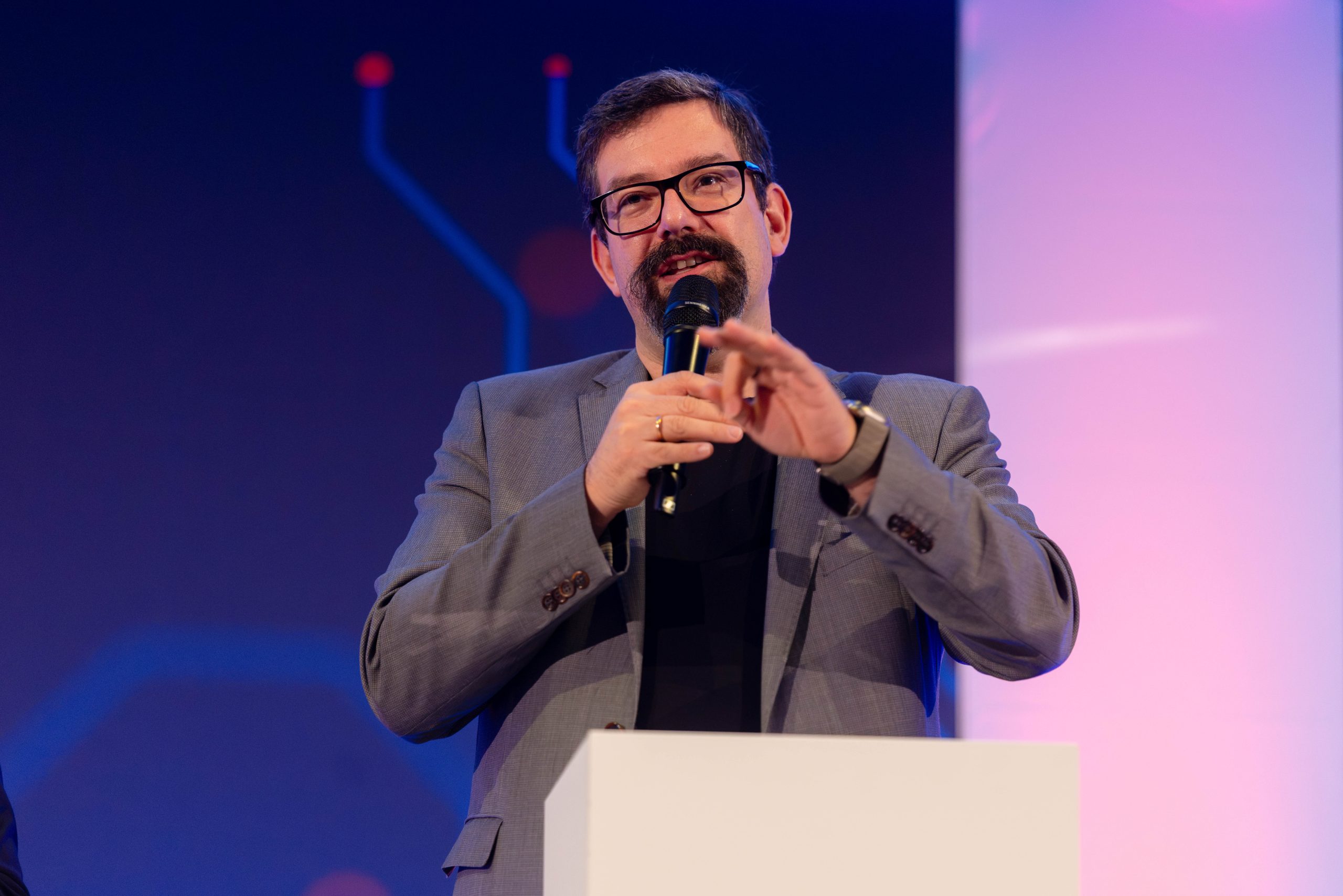
Dominik Bösl at INDUSTRIE DIGITAL 2026 in Hannover, explaining robotics. Photo credit: Florian Arp.

A clear assignment for a fascinating machine

My recommendation in the robotics forum was practical: describe a specific part of production you want to improve. Define what a good solution must deliver. That gives you a meaningful assignment to discuss with a supplier.

It sounds modest, but it is demanding. Wanting to deploy a humanoid robot tells us little about the benefit. Wanting to deliver particular parts to a workstation, on time and under defined conditions, opens a technical and economic investigation. A human-like form may help, or another configuration may be better. The task should guide that choice.

Simpler alternatives belong in the comparison. A different feeding arrangement, a redesigned workstation or a specialised robot may remove the same bottleneck. Assessing those options early gives a robotics project a stronger justification. I am enthusiastic enough about technology to recognise the temptation to reverse the sequence: acquire the machine first and then search for its purpose.

The economics also deserve scrutiny. Integration, training, maintenance and disruption come on top of the purchase price. Benefits may include less scrap, better ergonomics or time specialists can spend on their core work. Which benefits materialise must be established in the process concerned. A business case becomes more useful when its assumptions are explicit.

What shoelaces and shirts tell us about progress

The point raised in the closing discussion does not require a sweeping verdict on robotics research. Both a shoelace and a shirt can change shape, yet they present different challenges. The system must identify the object's configuration, choose a grasp and anticipate how its next movement changes that configuration. A successful method for one task does not establish dependable operation for the other.

This matters beyond robotics. We observe an impressive performance and mentally add capabilities that were never demonstrated. A human-like machine makes that especially tempting: two hands suggest universal dexterity. Its actual dexterity must be assessed through tasks.

I want to describe progress more precisely. Which variations can the system handle? How often does it need assistance? Does it recognise failure? Can it recover independently, or must someone restore the initial conditions? These questions give technical achievement its due by making clear what has been accomplished. They also indicate where development should go next.

Over the coming years, I would welcome greater attention to the work between mastering a movement and reliably completing an assignment. A short video rarely reveals all of it.

Knot manipulation and shoelace tying are longstanding research problems. An original university repository documents a shoe-tying prototype presented in 2014. That does not diminish today's advances. It illustrates why the existence of a demonstration and its readiness for industrial use are separate questions. The freely accessible abstract of that historical prototype does not establish industrial continuous operation.

Give suppliers a task to solve

My recommendation can therefore become a practical test: formulate a problem precisely enough to assess an offered solution. Give suppliers the same task, the same variations and the same success criteria. Let them demonstrate what works under those conditions.

The task might involve inserting a cable, handling a hose or automating a step in shoe production. These are examples of assessment tasks, rather than claims that each is fully automatable under arbitrary conditions. Your process determines which task makes sense. Describing it with employees often teaches you more than another broad promise.

Agree the measures before the trial. What quality is required? How many variants must be handled? What cycle time is necessary? How often may a person intervene? How long does recovery take? What do commissioning, changeovers and rework cost? How much physical or organisational strain does the application actually remove?

Compare against the current workflow and suitable alternatives. The trial report should include human interventions and failed cases. Otherwise, we may be comparing a complete operational process with a carefully selected excerpt.

A legitimate outcome is a decision to defer automation. Volumes may be too low, variation too high or costs excessive under current conditions. That is still a result. Companies needing support can involve integrators, research organisations or universities. Courage means investigating the question seriously and acting on the answer.

Production knowledge becomes an advantage when we use it

As the organiser's report records, Klöckner argued that German industry should help shape an industrial robotics data and software platform. That is his position. It connects with a question I approached from the application side in the forum: what do we do with our production knowledge?

People who have operated a process for years know its deviations. Employees recognise an unusual sound, a troublesome material variant and the reason for an apparently minor manual action. This knowledge can be decisive in developing a robotic solution. Collecting large volumes of data cannot simply replace it.

One of the next decade's most interesting challenges is to describe relevant knowledge, connect it with appropriate data and make it useful for development and testing. Failures and edge cases belong in that picture. A dataset containing only smooth operation tells part of the story.

There is also a strategic question: who benefits from the experience generated in a factory? Can a company reuse its data, switch solutions and assess performance independently? Or does each learning step mainly strengthen its supplier? Architecture, contracts and management decisions all matter. Industrial experience becomes a lasting advantage when companies turn it into an ability to act.
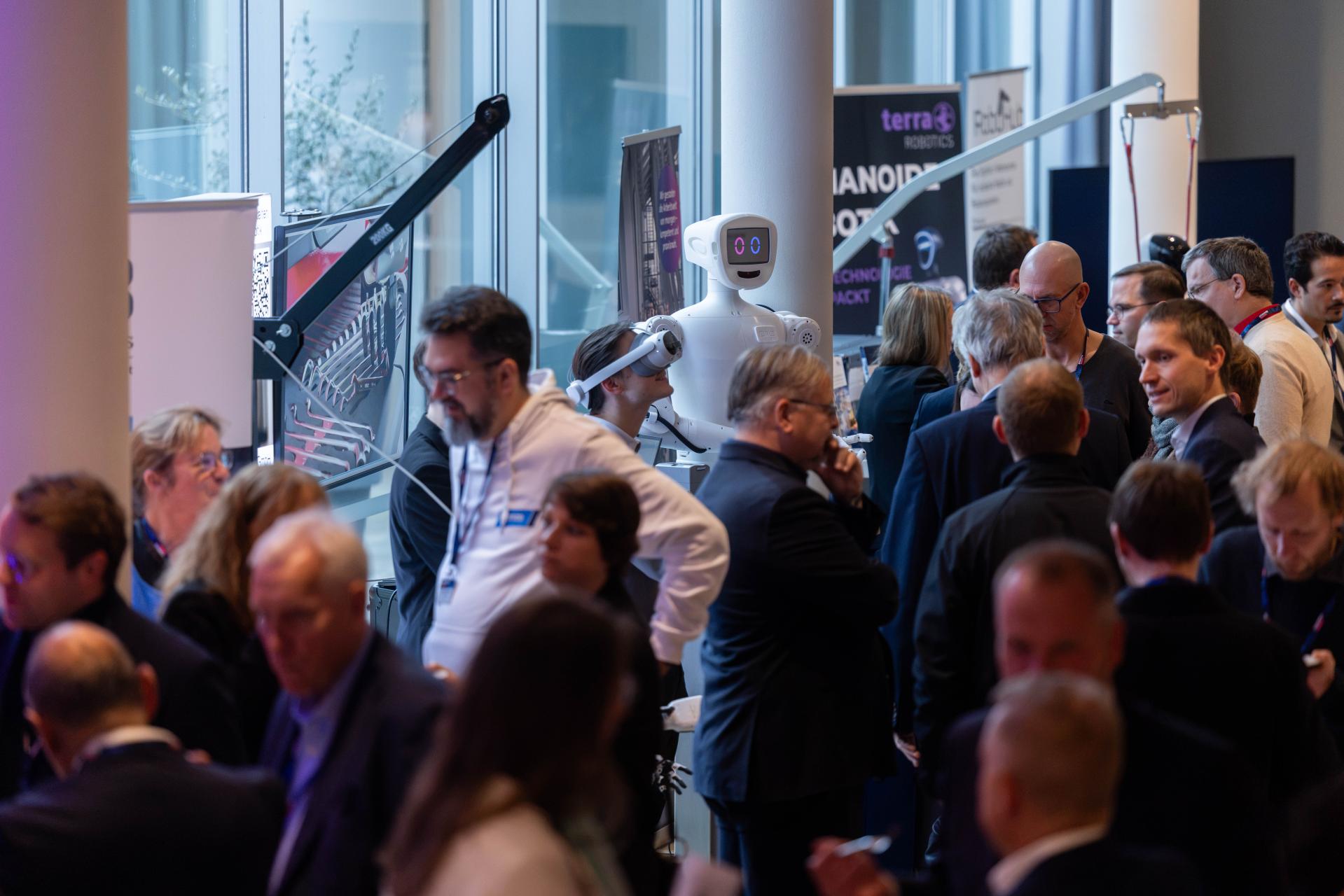
Participants talking between exhibition stands at INDUSTRIE DIGITAL 2026.
Between sessions: conversations, questions and exchanges in the exhibition area. Photo credit: Florian Arp / NiedersachsenMetall.

The organisation has to learn too

A pilot can produce two kinds of value: a productive application and knowledge about what that application still needs. Both can be worthwhile. We should agree in advance which we expect and how to recognise it.

A project intended mainly for learning needs bounded resources and a specific question. Can this component variant be recognised reliably? How much assistance does recovery need? What data are missing? Afterwards, the company should be able to decide whether to continue, adjust the scope or stop. A justified decision to stop can be good investment management.

Early employee involvement also featured in the forum discussions. My conclusion goes beyond acceptance: people at the workstation know many conditions the system will eventually encounter. Involving them only after technology selection wastes knowledge.

Universities and vocational education have a role here. Students and trainees should learn to question demonstrations, formulate requirements and test results under changed conditions. A laboratory robot provides a useful starting point. Learning comes from observing, explaining, measuring and improving it. My article on AI, skills and the future of work develops the education perspective.

Responsibility belongs in the trial

In the closing discussion, I was asked whether voluntary commitments would suffice for further development. I would not rely on those alone. We need experience gathered under responsible conditions and requirements derived from that experience.

For a company, this means specific work: describing the intended use, assigning responsibilities, setting boundaries and handling disruption. Who can stop a trial? Who investigates a failure? Which changes require further testing? Which employee feedback triggers a revision?

Learning systems make these questions more pressing because changes to software or data may affect behaviour. A successful demonstration should therefore open the conversation about operation rather than settle it.

My understanding of Robotic Governance connects technical development and societal responsibility. It includes willingness to experiment and the ability to set reasoned limits. Trust becomes more substantial when people can understand deployment conditions and what happens when something goes wrong.

Discussing robotics, applications and responsibility. Photo credit: Florian Arp.

One page that opens a conversation

Towards the end of the robotics forum, I returned to my call for participatory technology dialogue: public technology funding should be tied to an understandable one-page explanation. Anyone receiving public money should explain to the public what is being developed, the expected benefit, the limitations and the questions still open. This is my policy proposal; it is not a claim about an existing funding rule.

I include myself in the criticism. Researchers and industry professionals can talk at length about their work while leaving essential questions unanswered. What can the system do? Where are its limits? Who benefits? What consequences need discussion?

The page should enable informed debate. People may be interested in a technology, oppose a particular use or ask for different priorities. They need an accessible account of the subject to form that judgement. I explored the proposal in my New York and UN article on understandable technology funding.

For me, this is a practical part of democratic technology development. We need better conversations about technical possibilities, social preferences and what makes sense in a particular context.

I was pleased that the proposal received applause in the forum. It reinforced my view that explanation is a serious part of our work. Participation becomes meaningful when people can access the subject and form their own opinion.

My deliberately pointed concern about human foolishness also met with approval: irresponsible use of technology often worries me more than the label “artificial intelligence”. That gives technology designers no exemption from responsibility. Safety, misuse, incentives and harmful applications must be considered in development and deployment. Responsibility begins long before someone deliberately does something harmful.
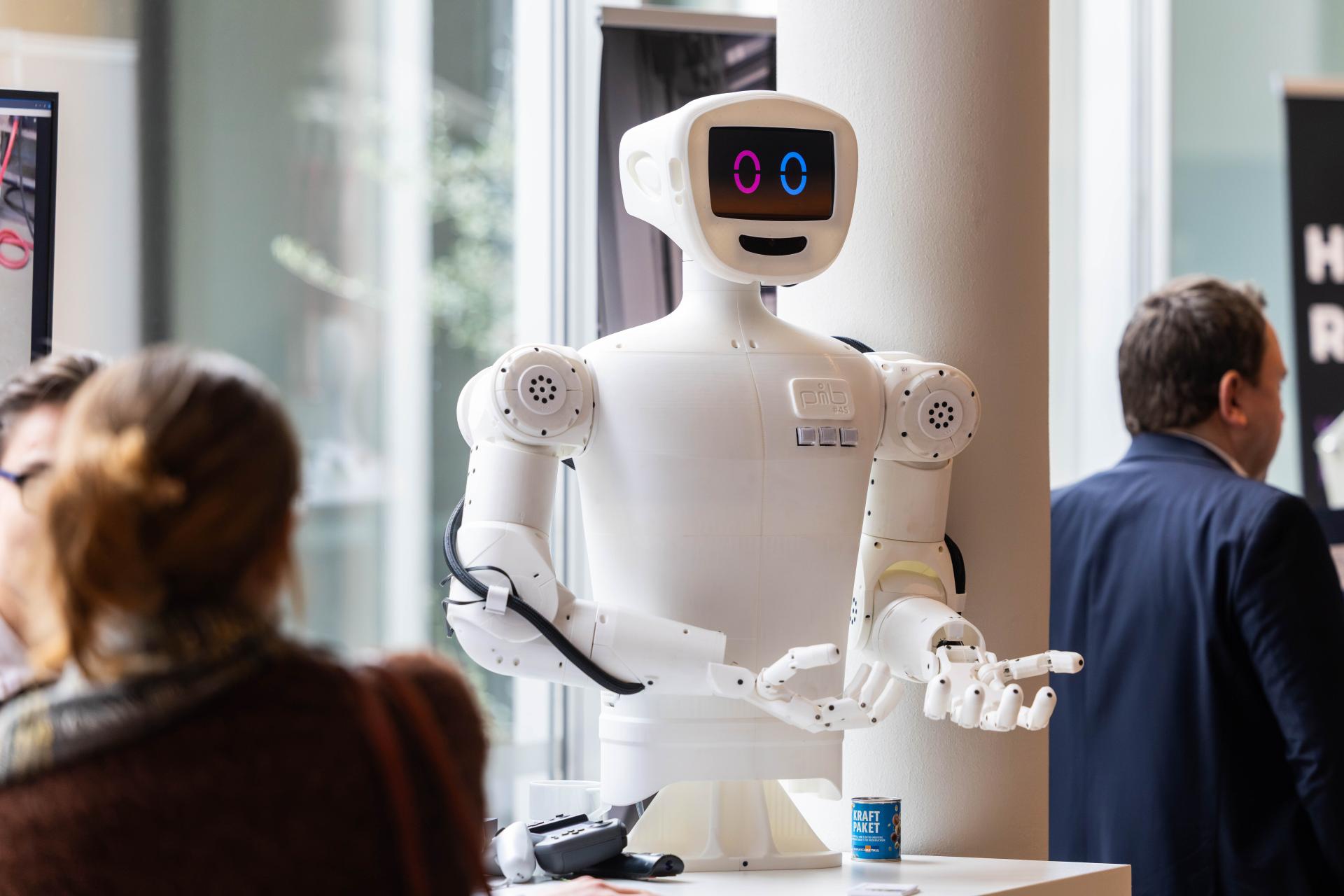
A white robot with arms and a screen face on display at INDUSTRIE DIGITAL 2026.
A robotics exhibit inviting a closer look and discussion. Photo credit: Florian Arp / NiedersachsenMetall.

My outlook to 2036: moving into less orderly worlds

When we meet again in ten years, I expect much more robotic support outside conventional factories: at work, in offices and retail, in suitable hospital tasks and at home. I have bounded, useful applications in mind. Service robotics already exists today. My forecast concerns wider adoption, greater flexibility and more demanding tasks.

The direction is from more controlled environments towards less structured ones. In a factory, we can arrange material feeding, define positions and bound a process. In a shop, customers move around. At home, a chair changes position, lighting varies and somebody puts a cup somewhere unexpected. Factories also contain substantial variation; the distinction describes a direction of development rather than a clean boundary.

I expect progress particularly where a clear benefit meets manageable operating conditions. That need not produce a rigid sequence from factory to office, retail, hospital and home. A narrowly defined task in a difficult setting may succeed before a highly variable task on a factory floor. Actual requirements determine the difficulty.

Showing and explaining instead of specifying every movement

I am particularly interested in how we communicate tasks to robots. I expect Teaching by Demonstration and Teaching by Explanation to become more important. The aim is to make setup and adaptation easier. An understandable instruction alone, however, cannot guarantee safe execution. The system must identify what it refers to, respect boundaries and recognise when it needs assistance.

That gives us a realistic picture of increasing autonomy: more situations handled independently, fewer unnecessary interventions and a clear response to situations outside the system's competence. I expect an evolution with substantial progress at different speeds. I do not expect a single day on which every everyday task suddenly becomes solvable.

The universal household helper remains an ambitious bet

By 2036, I do not expect widespread access to humanoid robots that cook, clean, tidy, feed the cat and cope with every household surprise. Impressive individual applications are entirely conceivable. Combining many abilities with safety, reliability, affordability and highly varied domestic conditions is a much larger requirement.

We should distinguish two concepts here. An agentic system may plan steps, use tools and act within limits. That establishes neither general robotic competence nor consciousness. My scepticism concerns a universal all-rounder that performs reliably in everyday life. It does not deny the usefulness of bounded autonomy. This direction connects with my Four Robotic Revolutions framework.

Dexterity does not establish consciousness

I also do not expect a generally accepted demonstration of feeling or conscious machines by 2036. That is my judgement within an open scientific and philosophical debate. Defining and establishing consciousness is already difficult; possible machine consciousness need not resemble human experience.

Perceptual performance, planning and behaviour should be distinguished from subjective experience. A robot may sense its surroundings and respond to people without thereby demonstrating an inner experience. Useful deployment calls for reliable abilities and responsible operating conditions. It cannot answer every question about consciousness.

Where we can begin

My practical conclusion from Hannover is to choose a useful application, understand its conditions and investigate with employees what it improves. Document the experience. Base the next decision on it. Explain what worked and what remains unresolved.

This is a demanding form of optimism. It welcomes enthusiasm and requires work on the conditions for success. When we meet again in 2036, I want to discuss applications that actually help people. One well-chosen problem is enough to begin with. We have plenty of those.

Further reading and the event video

The following video by 3QM / NiedersachsenMetall offers impressions of the congress. It is a short event recap, not a complete recording of the talks or discussions.

Congress photos: Photo credit: Florian Arp. Personal impressions and forecasts reflect my own perspective. Sources and editorial review: 18 November 2026.

Questions and answers: practical robotics and the outlook to 2036

What was INDUSTRIE DIGITAL 2026 in Hannover?

The congress took place on 11 November 2026 at Schloss Herrenhausen, focusing on robotics, AI and industrial applications. It was organised by NiedersachsenMetall, Lower Saxony's Ministry for Economic Affairs and Niedersachsen.next. This article is my personal reflection, complementing the organisers' accounts with technical interpretation and my outlook to 2036.

What separates a robotics demonstration from an industrial application?

A demonstration establishes a capability under particular conditions. Deployment also requires the intended variations, quality, cycle times, disruptions and safety conditions to be addressed. Documented performance, necessary human assistance and total process costs matter. An impressive video alone does not establish those properties.

Can a robot that ties shoelaces automatically fold shirts too?

That does not follow. Both tasks involve deformable objects but require different perception, grasping strategies and failure handling. A system can be developed for both; its performance on the second task requires evidence under the intended conditions.

What does Use Case Driven Robotics mean?

For me, robotics development begins with a specific task and its benefit. Requirements and success criteria are defined before choosing a system. Suitable technologies and alternatives are assessed against them. The configuration, including a possible humanoid form, follows from the application's requirements.

How should companies compare robotics offers?

Give suppliers the same precise task with representative variations. Measure quality, processing time, interventions, recovery, changeovers and total cost against agreed criteria. Compare results with the current workflow and suitable alternatives. The trial may also establish that an application is not yet economical under current conditions.

Why do employees and production knowledge matter?

Employees know variations, uncommon disruptions and manual steps that an idealised process description may omit. Early involvement improves requirements and testing. Suitable data matter for learning systems, but do not replace an explanation of the process and its edge cases.

Which everyday robots does Dominik Bösl expect by 2036?

I expect more specialised support in settings such as retail, offices, hospitals and homes. Clear benefit and manageable operating conditions will guide progress. I do not expect a widely available humanoid all-rounder for every household task by 2036. This is a personal forecast rather than an established future outcome.

What are Teaching by Demonstration and Teaching by Explanation?

Teaching by Demonstration uses examples of task performance; Teaching by Explanation uses descriptions, for example in natural language. Both aim to simplify setup and adaptation. The system must still translate the information into executable action, stay within its operating boundaries and handle uncertainty.

Does a useful robot need consciousness?

Observable perception or action does not establish subjective experience. For a particular application, we assess capability, reliability, safety and responsibility. Machine consciousness is a further open question. I do not expect a generally accepted demonstration of conscious machines by 2036; that is a forecast.

What is the one-page proposal for publicly funded technology?

I propose tying public technology funding to an understandable one-page explanation. It should make the purpose, expected benefits, limitations and open societal questions accessible. People without specialist training could then form an informed opinion and participate in technology dialogue. This is my proposal, rather than a claim about a current funding obligation.
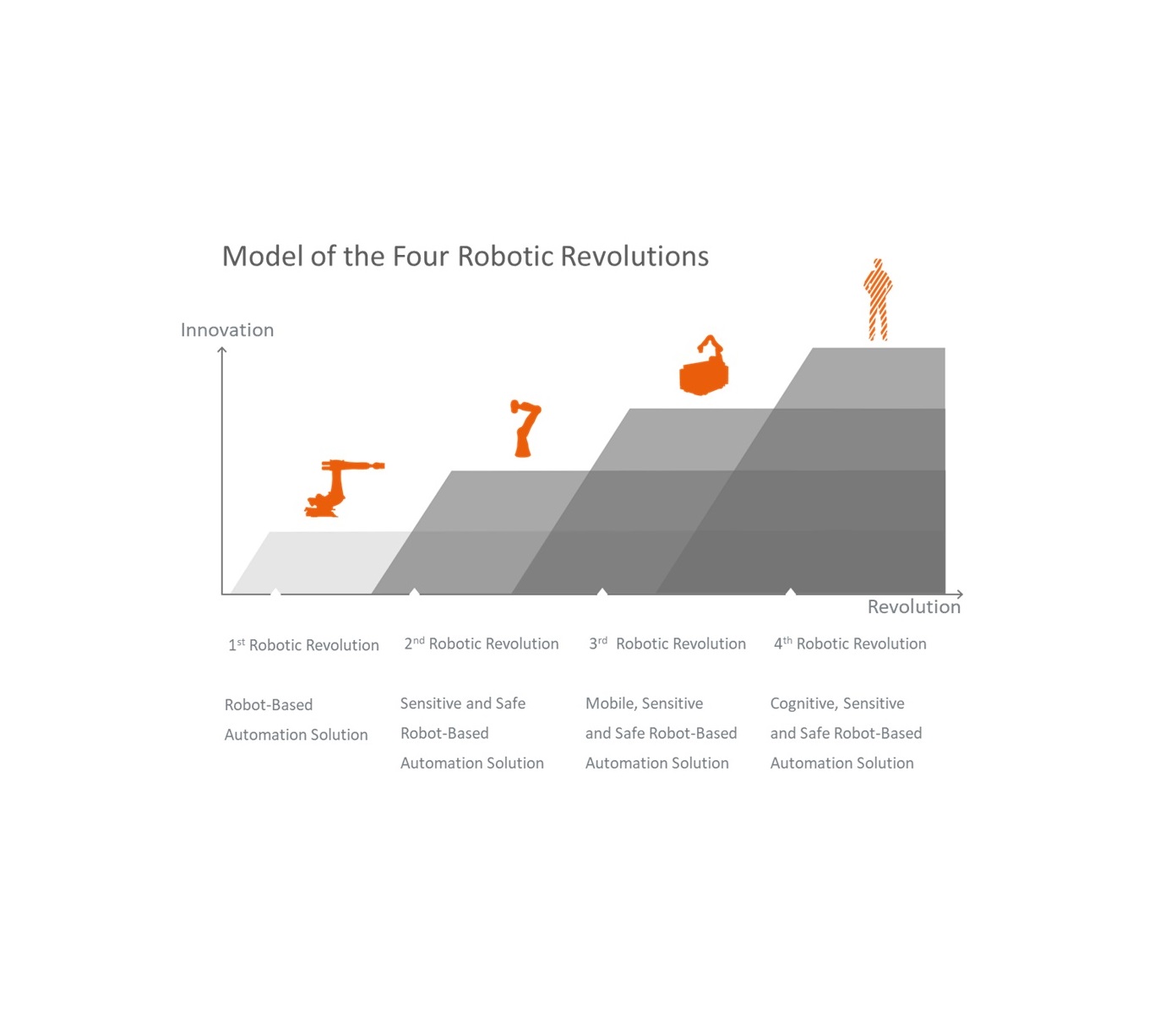
4 Robotic Revolutions: 10 Years On

4 Robotic Revolutions: 10 Years On

First published: 11 August 2024 (German original); this English version was published on 25 July 2026. Factual corrections and update: 4 October 2026.

Update, 4 October 2026: The following market data and FAQs reflect the July version. In World Robotics 2026, IFR reports a worldwide stock of five million industrial robots for 2025. The 2026 service robotics report has also been released. The AI Act omnibus amendment entered into force on 27 July 2026; the later legal position is explained in the dated update to the AI Act article.

Ten years after I first proposed the „4 Robotic Revolutions", the fourth revolution has stopped being a keynote promise. It has become an operations problem. I proposed the four phases in 2016 to bring order into a debate that treated every product launch as a revolution. On July 21, 2026, I used my opening keynote at the A3 Technology Transfer Congress in Augsburg to draw a first anniversary balance sheet. This article is the long-form version of that balance sheet. It is written not from the perspective of a demo lab, but from the perspective of the factories, hospitals, warehouses and lecture halls in which the four revolutions are actually competing for oxygen.

Stand in a workshop where a cobot works next to a human operator without a fence for the first time, and you understand immediately why categories matter. The cobot is not the event. The operator is not the event. The event is the process decision behind them: who is liable when the sensor misreads. Who stops the cell when the AI path planner picks a trajectory that looks unfamiliar to the human. Who trains maintenance to read adaptivity as designed behaviour rather than as a defect. These are the questions that I baked into the four phases of robotics a decade ago, because I had learned in KUKA innovation management, later at Festo, at Deutsches Museum and across many factory visits that technical readiness collapses on contact if organisational readiness is missing.

Why four revolutions in the first place

The idea was constructed by analogy with the evolution of the computer. Computers became smaller, then mobile, then ubiquitous, then invisible inside processes. Miniaturization, mobilization, ubiquity and pervasiveness described the move from the data centre to the smartphone to the embedded sensor. Robotics repeats those moves, in a different sequence: first the cage, then sensitivity, then mobility, then cognition. Together with Bernd Liepert, I proposed the four-phase model at IEEE IROS 2016 in Daejeon. The paper is titled „4 Robotic Revolutions - proposing a holistic phase model describing future disruptions in the evolution of robotics and automation and the rise of a new Generation R of Robotic Natives". The A3 region press release for the 2026 congress captured the core thesis in one sentence: four robotic revolutions, and the fourth is only just beginning (region-a3.com).

The phases are not a strict chronology. They overlap inside every plant, sometimes inside the same cell. Walk into a large factory today and you will find the first revolution in the body shop, the second in final assembly, the third in intralogistics, and the fourth in quality inspection and testing. The map is a maturity structure, not a timeline. To assess where an organisation stands, ask how the four phases relate to each other, which of them dominates, which is missing, and which is being underestimated.

Four robotic revolutions: caged automation, cobotics, mobile robotics and perceptive-cognitive systems over ten years

First revolution: the caged robot

The first revolution starts with a safety philosophy, not with a model. The robot goes behind a fence because its motion is too fast, too strong and too deterministic to accommodate human exceptions. In 2016 I described the core of this phase as „how to bolt, weld and glue a car together as fast as possible". The blunt formulation still holds. Anyone who has spent time in early Rüsselsheim, Wolfsburg or Toyota plants knows: the first revolution was an industrial programme, not a scientific one. Its successes were cycle time, process stability and the elimination of degrading physical labour.

The zoo, as I called those installations, was historical rather than chosen. The first generation of industrial robot arms dates back to the 1960s: Unimate entered service at General Motors in 1961, Kawasaki began production in Japan in 1969, and ASEA (later ABB) introduced the IRB 6 in 1974. The industrial premise was simple: human labour at the edge of tolerable physical strain had to be replaced by a reproducible, monotonous, exact motion. The side effects were high capital intensity, low flexibility, and a programming paradigm that created an entire profession, the robotics technician.

What tends to be forgotten: this phase remains our largest segment by volume. The International Federation of Robotics reports in World Robotics 2025 that 542,000 industrial robots were installed worldwide in 2024, the second highest annual figure in history. The operational stock reached 4.66 million units by the end of 2024, a nine percent increase year-on-year. The first revolution is not history. It is foundation. And it continues to scale because the protected workspace limits direct contact between people and machines. These installations also require a risk assessment and a sound safety concept.

Second revolution: the cobot leaves the cage

The second revolution is the one the general public got used to fastest. A cobot on a final assembly line looks harmless, almost like a better manipulator in a friendly coat of paint. Behind it, however, stands a research programme going back thirty years, driven by Oussama Khatib at Stanford, Gerd Hirzinger at the Institute of Robotics and Mechatronics at DLR, and an entire generation of force-torque-sensor developers. In 2016 I argued that market readiness only arrived around 2015, with KUKA LBR iiwa, the Universal Robots UR family and Rethink Robotics Baxter as the frontrunners. A decade later cobots are an established category. The IFR 2025 report documents that installations of collaborative robots continue to grow at double-digit rates worldwide.

What the second revolution really changed is not the sensor. It is the legitimacy of letting humans close to the machine. Sensitivity - force, torque, speed, redundant path planning - is the technical precondition. The genuine shift lies in safety philosophy: instead of relying solely on spatial separation by a fence, safety-related system functions can enable collaboration. The safety of the application must be assessed, including its tool, workpiece and specific task. This enables new cell layouts, new process designs and, more importantly, new roles inside teams. The operator is no longer a feeder for the robot. She is a process partner.

Honesty requires a caveat: in many German factories, cobots are still operated as if they were caged. They sit inside small safety zones, guarded by light curtains, and are not deployed in genuine collaboration. This is less a matter of technology than of risk assessments under DIN EN ISO 10218 and ISO/TS 15066, and of a shop-floor practice that does not always separate adaptivity cleanly from the formal approval framework. Real collaborative applications remain rare. But they were the door opener - and without the door opener of the second revolution, the third would not exist.

Third revolution: the robot comes to the workpiece

The third revolution inverts a basic assumption of automation. Until then, we brought the workpiece to the robot. In the third phase, the robot comes to the workpiece. Autonomous mobile platforms, mobile manipulators, AMRs and intralogistics robots change not only layouts, but investment decisions: any manufacturer that produces flexibly can only afford rigid cells for high-volume processes.

The IFR 2025 report documents a strong market push in autonomous mobile robots and in transportation and logistics. The service robotics statistics for 2024 count about 200,000 new professional service robots worldwide, more than half of them in transportation and logistics - 102,900 units in that single category, up 14 percent. In 2024, the RaaS fleet in transportation and logistics grew by 42 percent; across all surveyed application areas, it grew by 31 percent. These are not just numbers. They are an answer to the arithmetic that mid-sized companies have been working through for years: shorter product cycles, smaller batch sizes, higher variance, fewer people on night shifts.

What makes the third revolution hard is not the driving function. It is the handover. The mobile robot navigates the shop floor confidently, but the transfer between two processes - from shelf to cobot, from mobile platform to a machining station - creates interfaces that used to be either rigid cells or human hands. These interfaces are the actual battleground of service robotics. Personal robotics, home assisted living and care assistance depend on exactly this logic. The IFR 2025 report shows: medical robots grew by 91 percent in 2024 alone, the most dynamic category of the year. Rehabilitation and therapy robots doubled, robots for diagnostics and medical laboratory analysis together grew by 610 percent. These numbers cannot be filed away.

Fourth revolution: perception, cognition, agency

The fourth revolution is the one everyone talks about and few have actually deployed. Perceptive, cognitive, agentic systems - robots that sense, understand, decide and act. In my 2016 paper, I illustrated this future prospect through Rosie, the robotic housekeeper from The Jetsons, to make clear that this is no longer about programs. It is about behaviour. Ten years later, Rosie has not moved into anyone's household. But on the factory floor, the fourth revolution has pushed open two doors that will not close again.

The first door is programming. A perceptive-cognitive system is not taught point by point any more. It learns from demonstration, from simulation, from what actually happens on the shop floor. In many projects I have watched engineers demonstrate a process once and then let the system propose a workable trajectory. That is not yet general-purpose robotics, but it is a dramatic compression of what used to be programmed with coordinates, waypoints and hand-tuned trajectories.

The second door is commanding. A model that understands language can accept instructions outside its original programming envelope. A vision-language-action model turns an instruction into a sequence of actions. That is not trivial, and it is a qualitative change. The difference between a robot that operates a fixed cell and one that responds to natural language is comparable to the difference between a ticket machine and a human service agent. Both can bring you to your destination. Only one of them understands what to do when you missed your train.

The A3 press release captured my position in the following sentence: „The next industrial decade will not be won in models, but on Monday mornings when systems run for the first time without an observer standing next to them." I stand by that formulation. The fourth revolution is difficult not because the algorithms are missing. It is difficult because we have not yet built durable answers to the questions that emerge the moment a system decides without a human next to it. This is the point where Robotic and AI Governance stops being a nice-to-have and turns into an operational necessity.

Generation R and the transition to the Robotic Native

In parallel with the technical trajectory, in 2016 I proposed the idea of a new generation: Generation R. The term Robotic Native describes people who grow up with robots, in the way my generation grew up with computers, and today's children grow up with voice assistants. I first formulated the concept at the Gartner CIO Summit in 2013 and developed it as part of my doctoral research at TU Munich. The derivation goes back to John Perry Barlow's „Declaration of the Independence of Cyberspace" from 1996. Barlow wrote the network citizen, whom he called a native, into the history of the internet. We are, in his diction, immigrants of the net - and in mine, robotic immigrants.

In the German DigiKompetenz podcast in 2023, I put it as follows: our grandchildren will be Robotic Natives, our children not quite, and we and our children are the last generation of Robotic Immigrants. This is not nostalgia. It is an education policy statement. If we want the fourth revolution not to fail on social acceptance, we need to raise a generation of engineers, skilled workers, executives and citizens who not only work with robots, but grow up with them. Curriculum design, syllabi, further education formats, vocational schools and universities matter as much as the systems themselves.

Robotic and AI Governance as the frame

The four revolutions cannot be introduced productively without a governance frame. That is why I developed Robotic and AI Governance in parallel: as the research field that analyses the causes, characteristics and consequences of advances in robotics and automation as a megatrend. I formulated the concept for the first time at the Gartner CIO Summit in 2013, and detailed it as part of my doctoral research at TU Munich. The approach is deliberately soft: soft laws rather than hard laws, because legislation is too slow for technologies that mature within months. Interdisciplinary task forces, voluntary self-regulation, a professional code of conduct - similar to the arrangements in medicine, law and academia.

The intellectual grounding was worked out in the WeRobot 2015 panels with Peter Asaro, Jason Millar, Kristen Thomasen and others. And at the IEEE IROS Futurist Forums 2015 and 2016 with Oussama Khatib, Gerd Hirzinger and Tapio Heikkilä. I have written the core ideas of those debates into several blog posts, among them Robotic Governance: A regulatory framework for autonomous machines. Readers interested in the current governance debate will find the link to the EU AI Act and the principles of the papal encyclical Magnifica Humanitas.

The ideas have arrived - even where they are not cited

A ten-year balance sheet means, for me, first of all a look at where the ideas ended up. Sometimes with attribution, often without. That is not always academically comfortable, but it is a sign that the structure holds. I go through the institutions in whose work the four revolutions and the governance ideas have left visible traces.

International Federation of Robotics (IFR)

The IFR has been structuring its reports for years by several categories that, in my view, can be compared with the 4RR model: classical industrial robots, collaborative robots, mobile service robots, medical robots and, since 2025, explicitly also humanoid robots in the position paper „Vision and Reality" from August 14, 2025. I read these categories as points of reference for the development from cage to cobot to mobility and finally to cognition. This comparison describes my interpretation of the market data; it does not constitute an empirical test of the phase model.

euRobotics, eu-nited Robotics and Adra SRIDA

The European level picked up the framework early. euRobotics and eu-nited Robotics translated the four-stage structure into a strategic map in their Multi-Annual Roadmap for Robotics in Europe. The Adra AI, Data and Robotics Association has established its Strategic Research, Innovation and Deployment Agenda (SRIDA) across multiple editions as a reference for European framework programmes. Perception, cognition, autonomy and collaboration appear there as main categories of research funding, not as edge cases. This is the fourth revolution, in Brussels vocabulary.

VDMA Robotics + Automation

The VDMA Robotics + Automation Association is the German voice of the industry. Its market communication has been separating industrial robotics, service robotics, machine vision and integrated assembly solutions cleanly for years. The four phases sit underneath that segmentation as the conceptual scaffold. Since 2020, the VDMA has been pushing the combination of the third and fourth revolutions with growing intensity: mobile robotics plus AI-based perception as a joint showcase, notably at automatica. The press briefing for automatica 2025 made this the explicit lead theme.

VDE, VDI and the German standardization bodies

The German standardization world played two roles simultaneously. The VDE, with its analyses of the interaction between the EU AI Act and the Machinery Regulation, embedded the fourth revolution into a regulatory coordinate system - where robotics is no longer merely mechanical, but cognitive and learning. The VDI, with its guidelines on human-robot collaboration and autonomous systems, translated the transition between the second and fourth revolutions into a language that plants can act on. Without this standards work, cobot approvals would be much harder today, and the transition from adaptive to learning robotics would remain a blind spot in the approval pipeline.

UN DESA, UNCTAD and the United Nations

At the global level, UN DESA and UNCTAD have positioned robotics and AI as frontier technologies, with explicit ties to the 17 UN Sustainable Development Goals. The World Economic and Social Survey 2018 and the Technology and Innovation Report 2021 shaped the framing: robotics as both an enabler and an inhibitor of the SDGs. This ambivalence is what we analysed in detail in a 2021 IEEE IROS workshop paper, published in 2023 in Sustainable Production and Consumption. Consensus-based expert elicitation, applied to 169 SDG targets, shows that automation can secure food supply, scale healthcare delivery and enhance education, and that it can also deepen inequality, fragment work, and displace environmental costs. Anyone searching for traces of the 4RR ideas in UN publications will find them - sometimes explicitly, often in the underlying structure.

OECD, European Commission and the EU AI Act

The OECD cited the 4RR model directly in its 2021 report Making Life Richer, Easier and Healthier and used it in Table 1 on page 26 as a source for three generations of industrial robots: stationary, collaborative and flexible mobile systems. At the EU level, the EU AI Act is the central regulatory response to the fourth revolution. It hits especially hard where AI acts as a safety component in products - which is exactly where perceptive and cognitive systems meet robotics. The political agreement of May 7, 2026, reset the timing: high-risk systems under Annex III become applicable from December 2, 2027, and high-risk systems embedded in regulated products under Annex I from August 2, 2028 - documented among other places in the Commission's guidelines. The Machinery Regulation (EU) 2023/1230 completes the picture: AI-based safety components in machinery are regulated jointly through machinery law and AI Act. I have been part of these transitions, in panels, hearings and position papers. For a deeper reading, see my blog post on the AI Act.

IEEE, ISO and the technical-scientific community

On the scientific side, IEEE RAS standards, the IEEE Standards Strategy Meeting, and ISO Technical Committee TC 299 „Robotics" have absorbed the four-stage systematics into their working structures. In the IEEE RAS community, I laid out the interplay between 4RR, standards and translational research in 2019 in the Industry Forum and in a piece for the IEEE RAS Magazine, „Predicting the Future of Robotics and Making It Matter for Industry". The Delphi study Robotics 2050+, which I initiated together with colleagues in 2019, surveyed more than 200 experts worldwide and used the four phases implicitly as a scaffold without needing to defend the model. That is the most rewarding form of dissemination: a model that becomes background common sense.

What the fourth revolution costs us when we introduce it badly

In many keynotes I have quoted factory visits, because they anchor the model. In a Bavarian automotive reference plant, three years ago, I watched an AI-based visual inspection system deployed at an inbound station. Within six weeks, scrap rates dropped by twelve percent. The engineers celebrated. Six months later the call came in: a batch that the system had cleared without complaint had failed at the customer. No one could reconstruct why the model had decided the way it did. No training dataset had been archived. No confidence score had been logged. No rollback mechanism had been defined. What had begun as an efficiency win ended as a compliance case because no one had operationalized the fourth revolution.

This anecdote is the kernel of what I said in the A3 keynote: the next industrial decade will not be won in models, but on Monday mornings. Anyone who thinks that dropping a vision-language model into a manufacturing cell is a software project has not understood the process. It is a governance project with a software component. The four questions I ask in every project are:

If these four questions have no answer, introducing the fourth revolution is not progress. It is a risk hiding behind a KPI.

Impact chapter: where the ideas continue to work

I try to describe the impact of the 4RR model soberly. Some citations are explicit - OECD, IEEE RAS Magazine, the SDG paper. Others are implicit - the IFR reporting structure, the European SRIDA categories, the VDMA market segmentation. Others are cultural - the German WELT article „The four stages of the robotics revolution", the Schaeffler Tomorrow magazine with interviews on the model, podcasts, keynote circuits, curriculum documents from several universities.

Ten years after publication, I see three levels on which the model has continued to work. First: as a taxonomy for market observation and policy advice. Second: as an educational structure in universities, vocational schools and executive education formats. Third: as an argumentative device in governance debates - from the EU AI Act to ethics commissions of industry associations. That breadth was not predictable in 2016. Today it is the reason not to revise the categories artificially. The language will keep evolving, but the skeleton holds.

What 2035 will look different

Ten years after 2016, my view of the future is more sober than it was then. I do not believe that there will be humanoid household robots across the board in 2035. The IFR position paper „Humanoid Robots: Vision and Reality" from August 2025 states this very cleanly: the deployment focus will lie in the service sector and in industrial collaboration, not in the living room. What I expect for 2035 are four shifts.

First: the fourth revolution will become dominant in niches. Quality assurance, testing, intralogistics, rehabilitation, agriculture. Wherever perception and cognition translate directly into process quality, critical mass will form.

Second: cobots will become standard productivity tools in the same way CNC machines are today. No aha moment any more, just default equipment in the mid-market. That is not a revolution, that is a maturity marker.

Third: mobile systems will become routine in factories. Autonomous transport systems, mobile manipulators, robot-as-a-service contracts. The mid-market will rent robotics as it rents electricity today. The IFR 2025 report already shows that the RaaS fleet in transportation and logistics grew by 42 percent in 2024; across all surveyed application areas, it grew by 31 percent.

Fourth: the governance debate will operationalize. Where the EU AI Act is still being discussed today, in 2035 audit processes, model registries and operational log standards will be in place. Without this operating system, the fourth revolution will remain an innovation promise that fails on the first night shift.

Ten years on: what I would write differently today

Honest self-criticism is part of the anniversary. I would rewrite the 2016 paper in three places today.

First: I described the AI element of the fourth revolution as „perceptive, cognitive". Today I know that vision-language-action models and foundation models create their own commanding layer that could not be anticipated in 2016. I would add a dedicated subsection on „Grounded Language Interaction".

Second: I mentioned the governance layer, but I did not formulate it as an independent axis. Today I would describe governance not as an appendix but as a cross-cutting theme that runs through all four revolutions. Robotic and AI Governance is not an add-on to robotics. It is its operating system.

Third: I described Generation R as an educational prognosis. Today I would frame it as an educational obligation. If we want to train Robotic Natives, we need curricula that start earlier and that connect vocational training and higher education cleanly. This is a task for ministries of education, not for the robotics community alone.

Why the A3 keynote in 2026 is a good anniversary

The A3 region - Augsburg, Aichach-Friedberg, Landsberg - is a precise testing ground for the 4RR model. Mid-market companies here run processes across body-in-white, final assembly, precision machining and intralogistics transitions. When I speak in Augsburg, I speak to owners who see all four revolutions inside their own plants. The A3 press release for the 2026 congress summarized this in one sentence: what is at stake is not only technical readiness, but regulatory and social questions - who is liable, who decides, who trains.

In Augsburg I did not present a marketing outlook. I presented a balance sheet. The audience did not ask for roadmaps, they asked for operational playbooks. That is where the last ten years' progress actually lives: an academic model has turned into a tool for plant managers. From there, in the coming decade, it will turn into an everyday practice, measurable on Monday mornings when systems run for the first time without an observer.

FAQ: The four Robotic Revolutions

What are the 4 Robotic Revolutions?

The 4 Robotic Revolutions are a phase model that Bernd Liepert and I published in 2016 at IEEE IROS in Daejeon. It orders the evolution of robotics into four stages: classical industrial robotics behind fences, collaborative sensitive robotics, mobile sensitive robotics, and perceptive, cognitive and agentic systems. By analogy with the evolution of computing (miniaturization, mobilization, ubiquity, pervasiveness), the model describes the transition from a rigid automator to a sensitive-mobile-cognitive assistant. It is used today as a reference frame in IFR market reports, EU research programmes, VDMA market segmentation and governance debates.

Why is the fourth revolution the decisive one?

The fourth revolution - perceptive, cognitive, agentic systems - is decisive because it simultaneously changes the programming logic and the commanding logic. Robots are no longer taught point by point. They learn from demonstration, from simulation and from operational data. They respond to natural language and make decisions without an immediate human in the loop. Responsibility, liability and auditability shift accordingly. The decisive question is no longer whether a system works technically, but whether an organisation can operate it cleanly.

What is the difference between a cobot and a classical industrial robot?

A classical industrial robot operates behind a fence. Its motion is fast, forceful and deterministic. Safety comes from spatial separation. A cobot can enable collaboration, for example through power and force limiting. Whether a fence can be omitted depends on the complete application: tool, workpiece, movement and workplace must be assessed together, and the safety concept must be validated. In practice, cobots are still frequently operated inside safety zones - not because the technology is missing, but because of risk assessments under DIN EN ISO 10218 and ISO/TS 15066. Genuine collaborative applications remain rare. They are, however, the foundation for everything that follows from the third revolution onward.

How do the four revolutions differ from Industry 4.0?

Industry 4.0 is a production and data-centred concept focused on networking, cyber-physical systems and digital twins. The 4 Robotic Revolutions are a robotics-centred phase model focused on physical interaction, sensitivity, mobility and cognition. The two frameworks complement each other. A plant can be advanced on Industry 4.0 metrics while still stuck in the first or second robotic revolution, or vice versa. Governance debates increasingly run along the Robotic Revolutions axis, because the liability and safety questions are more sharply defined there.

FAQ: Generation R and Robotic Natives

Who is Generation R and what is a Robotic Native?

Generation R is the generation that grows up with robots, in the way my generation grew up with computers and today's children grow up with voice assistants. A Robotic Native is a person who experiences robotics as an everyday given, not as a novelty. I first formulated both terms in 2013 at the Gartner CIO Summit and elaborated them as part of my doctoral research at TU Munich. The derivation traces back to John Perry Barlow's Declaration of the Independence of Cyberspace from 1996. Robotic Natives will think, learn and work differently. They will experience robotics not as an innovation, but as infrastructure.

When will Generation R arrive in the workplace?

In the German DigiKompetenz podcast in 2023 I put it this way: our grandchildren will be Robotic Natives, our children not quite, and we and our children are the last generation of Robotic Immigrants. Translated into operational terms, this means that in the next ten to fifteen years Generation R will start to arrive in vocational training and higher education. In manufacturing, in maintenance and in process ownership, it will become visible from the mid 2030s. Any company that does not adjust its training profile now will face a structural disadvantage after 2030.

How does Generation R connect to the fourth revolution?

Generation R and the fourth revolution are a pair. The fourth revolution provides robotic systems that can be interacted with linguistically and intuitively. Generation R provides the humans who take that interaction for granted. Without Generation R, the fourth revolution risks failing on skills shortages and acceptance barriers. Without the fourth revolution, Generation R remains a marketing figure without a distinctive everyday reality.

What does this mean for education and further training?

Curricula need to embed robotics foundations earlier, not as an extra module but as a cross-cutting theme. Anyone training electronics technicians, mechatronics technicians, IT specialists or logistics workers has to include robotics fundamentals as part of the profile. At the university level, this means linking business informatics, mechanical engineering, industrial engineering and computer science so that the fourth revolution does not end up siloed. For executives, this means that further training in Robotic and AI Governance is no longer optional. It is foundational.

FAQ: Robotic and AI Governance

What is Robotic and AI Governance?

Robotic and AI Governance is the research field that analyses the causes, characteristics and consequences of advances in robotics and automation as a megatrend. I first formulated the term in 2013 at the Gartner CIO Summit and elaborated it as part of my doctoral research at TU Munich. The approach is deliberately soft: soft laws rather than hard laws, because legislation is too slow for technologies that mature within months. Interdisciplinary task forces, voluntary self-regulation, professional codes of ethics and international standards are the central instruments. The goal is a responsibility architecture that combines technical safety, social acceptance and economic use.

How does Robotic and AI Governance relate to the EU AI Act?

The EU AI Act is a hard-law response to the fourth revolution. It hits especially hard where AI acts as a safety component embedded in products - which is exactly where robotics as a perceptive-cognitive system operates. The political agreement of May 7, 2026 reset the timing: high-risk systems under Annex III become applicable from December 2, 2027, and systems embedded in regulated products under Annex I from August 2, 2028. Robotic and AI Governance is the soft frame that makes the AI Act operable in day-to-day plant reality. Without this frame the AI Act remains a compliance document. With this frame it becomes an operating rule.

What role does the Machinery Regulation play for robots?

Position in the July 2026 version: The Machinery Regulation (EU) 2023/1230 replaces the Machinery Directive and generally applies from January 20, 2027. It governs safety requirements for machinery, including robots, and interacts closely with the EU AI Act. The political agreement of May 2026 provides for largely exempting machinery from direct AI Act applicability. The amending regulation published on July 24, 2026 does not enter into force until July 27. Safety-relevant AI components in machinery will primarily be addressed through delegated acts under the Machinery Regulation itself. This is an important compromise: it avoids double regulation but requires manufacturers to model the interaction cleanly inside their own conformity assessments.

Update, 4 October 2026: Amending Regulation (EU) 2026/1744 has been in force since 27 July 2026.

What does this mean for the mid-market?

For the mid-market it means that the fourth revolution is only productive if governance grows with it. The four questions I ask in every project are: who stops the system, who is liable, who trains the shift, who archives the model. Companies that can answer these four questions inside their own operation can turn robotics into competitive advantage. Companies that ignore them will build a compliance case with lead time. Do not wait for software that handles governance for you. It will not come. Governance is leadership work.

FAQ: Impact, institutions and the next ten years

Who cites the 4 Robotic Revolutions model?

The model is cited explicitly in an OECD report on robotics from 2021, in IEEE RAS publications, and in the SDG paper from 2021 and 2023 in Sustainable Production and Consumption. Implicitly, the structure appears in IFR World Robotics reports, in the SRIDA documents of the Adra AI, Data and Robotics Association, in the Multi-Annual Roadmap for Robotics in Europe by eu-nited Robotics and in VDMA market segmentation. Culturally, it appears in interviews, podcasts and articles, including the German WELT article 'The four stages of the robotics revolution' and in Schaeffler Tomorrow. That breadth, ten years after publication, is the actual balance sheet.

How does robotics affect the UN Sustainable Development Goals?

Robotics is both enabler and inhibitor of the 17 UN Sustainable Development Goals. In a paper started at the IEEE IROS workshop 2021 and published in 2023 in Sustainable Production and Consumption, my co-authors (Haidegger, Khamis, Mai, Moerch, Rao, Jacobs, Lach, Vanderborght) and I applied consensus-based expert elicitation to 169 SDG targets. Robotics can secure food supply, scale healthcare and improve education. It can also deepen inequality, fragment work and displace environmental costs. The mapping is complex and should not be reduced to an enabler-only narrative. UN DESA and UNCTAD have picked up this ambivalence in their Frontier Technologies reports.

What role will humanoid robots play in the next ten years?

Humanoid robots are the most visible symbol of the fourth revolution, but they will not play a dominant everyday role in the next ten years. The IFR position paper 'Humanoid Robots: Vision and Reality' from August 2025 puts it clearly: the deployment focus lies first in the service sector and in industrial collaboration applications, not in the household. China has concrete plans for mass production, and US and European companies are investing, but the forecast is serial production for specialized applications. I expect humanoid robots to become a significant niche field by 2035, comparable to medical robotic assistants today.

What is the most important sentence from the A3 keynote 2026?

The most important sentence in my A3 keynote 2026 is: the next industrial decade will not be won in models, but on Monday mornings when systems run for the first time without an observer standing next to them. This is not a rhetorical flourish. It is the core thesis of my ten-year balance sheet on the 4 Robotic Revolutions. Anyone who misreads the fourth revolution as a model innovation will underestimate its operational requirements. Anyone who recognizes it as an organisational challenge will be able to handle it. This is the central message I brought to Augsburg for the A3 congress.

Sources and further reading