4 Robotic Revolutions: 10 Years On

4 Robotic Revolutions: 10 Years On

Ten years after I first proposed the „4 Robotic Revolutions", the fourth revolution has stopped being a keynote promise. It has become an operations problem. I proposed the four phases in 2016 to bring order into a debate that treated every product launch as a revolution. On July 21, 2026, I used my opening keynote at the A3 Technology Transfer Congress in Augsburg to draw a first anniversary balance sheet. This article is the long-form version of that balance sheet. It is written not from the perspective of a demo lab, but from the perspective of the factories, hospitals, warehouses and lecture halls in which the four revolutions are actually competing for oxygen.

Stand in a workshop where a cobot works next to a human operator without a fence for the first time, and you understand immediately why categories matter. The cobot is not the event. The operator is not the event. The event is the process decision behind them: who is liable when the sensor misreads. Who stops the cell when the AI path planner picks a trajectory that looks unfamiliar to the human. Who trains maintenance to read adaptivity as designed behaviour rather than as a defect. These are the questions that I baked into the four phases of robotics a decade ago, because I had learned in KUKA innovation management, later at Festo, at Deutsches Museum and across many factory visits that technical readiness collapses on contact if organisational readiness is missing.

Why four revolutions in the first place

The idea was constructed by analogy with the evolution of the computer. Computers became smaller, then mobile, then ubiquitous, then invisible inside processes. Miniaturization, mobilization, ubiquity and pervasiveness described the move from the data centre to the smartphone to the embedded sensor. Robotics repeats those moves, in a different sequence: first the cage, then sensitivity, then mobility, then cognition. Together with Martin Bode, I proposed the four-phase model at IEEE IROS 2016 in Daejeon. The paper is titled „4 Robotic Revolutions - proposing a holistic phase model describing future disruptions in the evolution of robotics and automation and the rise of a new Generation R of Robotic Natives". The A3 region press release for the 2026 congress captured the core thesis in one sentence: four robotic revolutions, and the fourth is only just beginning (region-a3.com).

The phases are not a strict chronology. They overlap inside every plant, sometimes inside the same cell. Walk into a large factory today and you will find the first revolution in the body shop, the second in final assembly, the third in intralogistics, and the fourth in quality inspection and testing. The map is a maturity structure, not a timeline. To assess where an organisation stands, ask how the four phases relate to each other, which of them dominates, which is missing, and which is being underestimated.
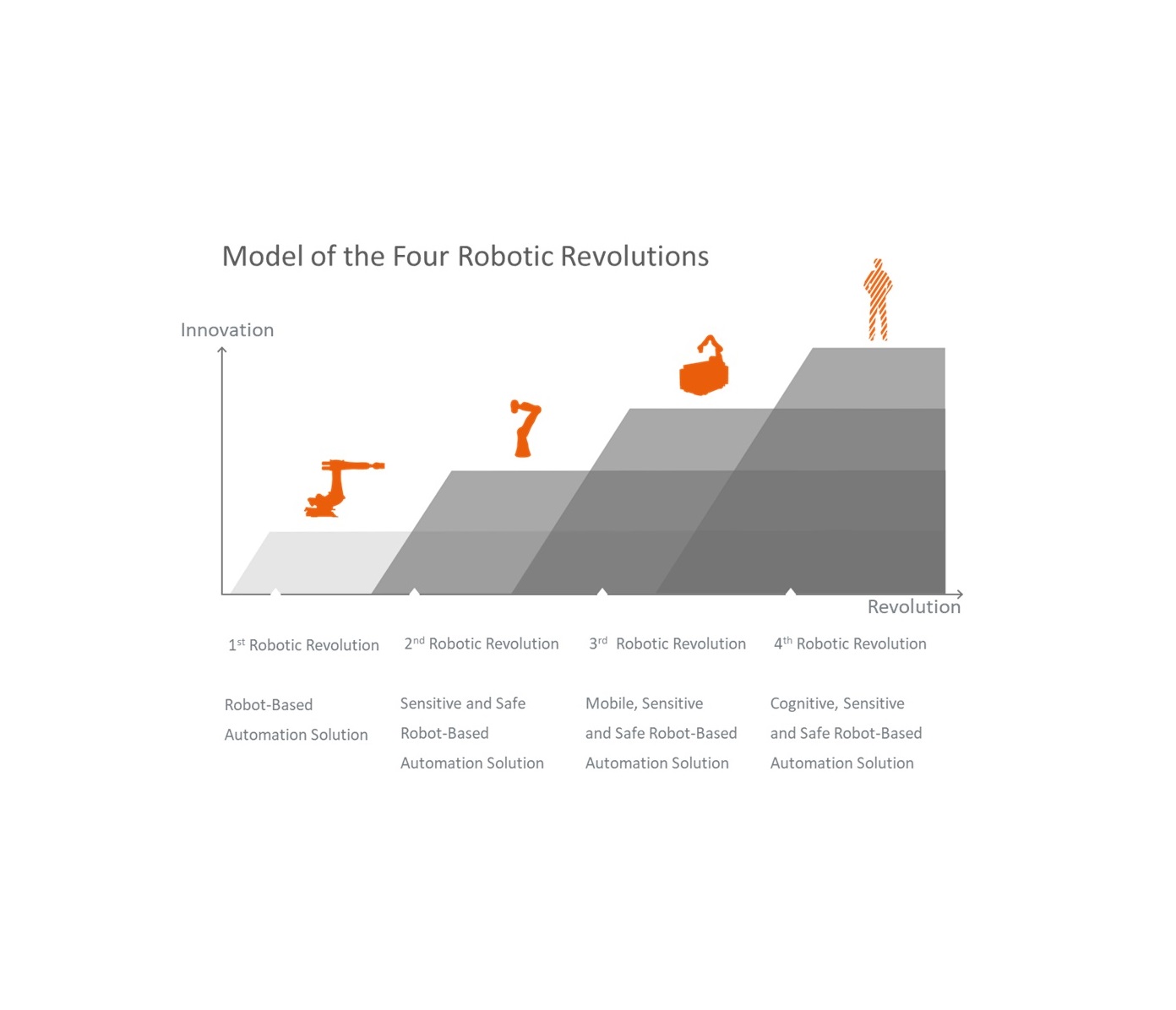
Four robotic revolutions: caged automation, cobotics, mobile robotics and perceptive-cognitive systems over ten years

First revolution: the caged robot

The first revolution starts with a safety philosophy, not with a model. The robot goes behind a fence because its motion is too fast, too strong and too deterministic to accommodate human exceptions. In 2016 I described the core of this phase as „how to bolt, weld and glue a car together as fast as possible". The blunt formulation still holds. Anyone who has spent time in early Rüsselsheim, Wolfsburg or Toyota plants knows: the first revolution was an industrial programme, not a scientific one. Its successes were cycle time, process stability and the elimination of degrading physical labour.

The zoo, as I called those installations, was historical rather than chosen. The first industrial robot arms came out of the early 1970s, led by Unimate at General Motors and the first cells installed by Kawasaki and ASEA (later ABB) in Europe. The industrial premise was simple: human labour at the edge of tolerable physical strain had to be replaced by a reproducible, monotonous, exact motion. The side effects were high capital intensity, low flexibility, and a programming paradigm that created an entire profession, the robotics technician.

What tends to be forgotten: this phase remains our largest segment by volume. The International Federation of Robotics reports in World Robotics 2025 that 542,000 industrial robots were installed worldwide in 2024, the second highest annual figure in history. The operational stock reached 4.66 million units by the end of 2024, a nine percent increase year-on-year. The first revolution is not history. It is foundation. And it continues to scale precisely because it solves the exception problem elegantly: it removes it.

Second revolution: the cobot leaves the cage

The second revolution is the one the general public got used to fastest. A cobot on a final assembly line looks harmless, almost like a better manipulator in a friendly coat of paint. Behind it, however, stands a research programme going back thirty years, driven by Oussama Khatib at Stanford, Gerd Hirzinger at the Institute of Robotics and Mechatronics at DLR, and an entire generation of force-torque-sensor developers. In 2016 I argued that market readiness only arrived around 2015, with KUKA LBR iiwa, the Universal Robots UR family and Rethink Robotics Baxter as the frontrunners. A decade later cobots are an established category. The IFR 2025 report documents that installations of collaborative robots continue to grow at double-digit rates worldwide.

What the second revolution really changed is not the sensor. It is the legitimacy of letting humans close to the machine. Sensitivity - force, torque, speed, redundant path planning - is the technical precondition. The genuine shift lies in safety philosophy: instead of separation by fence, we rely on inherent safety by system behaviour. This enables new cell layouts, new process designs and, more importantly, new roles inside teams. The operator is no longer a feeder for the robot. She is a process partner.

Honesty requires a caveat: in many German factories, cobots are still operated as if they were caged. They sit inside small safety zones, guarded by light curtains, and are not deployed in genuine collaboration. This is less a matter of technology than of risk assessments under DIN EN ISO 10218 and ISO/TS 15066, and of a shop-floor practice that does not always separate adaptivity cleanly from the formal approval framework. Real collaborative applications remain rare. But they were the door opener - and without the door opener of the second revolution, the third would not exist.

Third revolution: the robot comes to the workpiece

The third revolution inverts a basic assumption of automation. Until then, we brought the workpiece to the robot. In the third phase, the robot comes to the workpiece. Autonomous mobile platforms, mobile manipulators, AMRs and intralogistics robots change not only layouts, but investment decisions: any manufacturer that produces flexibly can only afford rigid cells for high-volume processes.

The IFR 2025 report documents a strong market push in autonomous mobile robots and in transportation and logistics. The service robotics statistics for 2024 count about 200,000 new professional service robots worldwide, more than half of them in transportation and logistics - 102,900 units in that single category, up 14 percent. Robot-as-a-service models grew disproportionately at 42 percent. These are not just numbers. They are an answer to the arithmetic that mid-sized companies have been working through for years: shorter product cycles, smaller batch sizes, higher variance, fewer people on night shifts.

What makes the third revolution hard is not the driving function. It is the handover. The mobile robot navigates the shop floor confidently, but the transfer between two processes - from shelf to cobot, from mobile platform to a machining station - creates interfaces that used to be either rigid cells or human hands. These interfaces are the actual battleground of service robotics. Personal robotics, home assisted living and care assistance depend on exactly this logic. The IFR 2025 report shows: medical robots grew by 91 percent in 2024 alone, the most dynamic category of the year. Rehabilitation and therapy robots doubled, diagnostic robots grew by 610 percent. These numbers cannot be filed away.

Fourth revolution: perception, cognition, agency

The fourth revolution is the one everyone talks about and few have actually deployed. Perceptive, cognitive, agentic systems - robots that sense, understand, decide and act. In 2016 I described this phase as „the Rosie the Jetsons' housekeeper still vision", to make clear that this is no longer about programs. It is about behaviour. Ten years later, Rosie has not moved into anyone's household. But on the factory floor, the fourth revolution has pushed open two doors that will not close again.

The first door is programming. A perceptive-cognitive system is not taught point by point any more. It learns from demonstration, from simulation, from what actually happens on the shop floor. In many projects I have watched engineers demonstrate a process once and then let the system propose a workable trajectory. That is not yet general-purpose robotics, but it is a dramatic compression of what used to be programmed with coordinates, waypoints and hand-tuned trajectories.

The second door is commanding. A model that understands language can accept instructions outside its original programming envelope. A vision-language-action model turns an instruction into a sequence of actions. That is not trivial, and it is a qualitative change. The difference between a robot that operates a fixed cell and one that responds to natural language is comparable to the difference between a ticket machine and a human service agent. Both can bring you to your destination. Only one of them understands what to do when you missed your train.

The A3 press release captured my position in the following sentence: „The next industrial decade will not be won in models, but on Monday mornings when systems run for the first time without an observer standing next to them." I stand by that formulation. The fourth revolution is difficult not because the algorithms are missing. It is difficult because we have not yet built durable answers to the questions that emerge the moment a system decides without a human next to it. This is the point where Robotic and AI Governance stops being a nice-to-have and turns into an operational necessity.

Generation R and the transition to the Robotic Native

In parallel with the technical trajectory, in 2016 I proposed the idea of a new generation: Generation R. The term Robotic Native describes people who grow up with robots, in the way my generation grew up with computers, and today's children grow up with voice assistants. I first formulated the concept at the Gartner CIO Summit in 2013 and developed it in my PhD dissertation at TU Munich. The derivation goes back to John Perry Barlow's „Declaration of the Independence of Cyberspace" from 1996. Barlow wrote the network citizen, whom he called a native, into the history of the internet. We are, in his diction, immigrants of the net - and in mine, robotic immigrants.

In the German DigiKompetenz podcast in 2023, I put it as follows: our grandchildren will be Robotic Natives, our children not quite, and we and our children are the last generation of Robotic Immigrants. This is not nostalgia. It is an education policy statement. If we want the fourth revolution not to fail on social acceptance, we need to raise a generation of engineers, skilled workers, executives and citizens who not only work with robots, but grow up with them. Curriculum design, syllabi, further education formats, vocational schools and universities matter as much as the systems themselves.

Robotic and AI Governance as the frame

The four revolutions cannot be introduced productively without a governance frame. That is why I developed Robotic and AI Governance in parallel: as the research field that analyses the causes, characteristics and consequences of advances in robotics and automation as a megatrend. I formulated the concept for the first time at the Gartner CIO Summit in 2013, and detailed it in my PhD dissertation at TU Munich. The approach is deliberately soft: soft laws rather than hard laws, because legislation is too slow for technologies that mature within months. Interdisciplinary task forces, voluntary self-regulation, a professional code of conduct - similar to the arrangements in medicine, law and academia.

The intellectual grounding was worked out in the WeRobot 2015 panels with Peter Asaro, Jason Millar, Kristen Thomasen and others. And at the IEEE IROS Futurist Forums 2015 and 2016 with Oussama Khatib, Gerd Hirzinger and Tapio Heikkilä. I have written the core ideas of those debates into several blog posts, among them Robotic Governance: A regulatory framework for autonomous machines. Readers interested in the current governance debate will find the link to the EU AI Act and the principles of the papal encyclical Magnifica Humanitas.

The ideas have arrived - even where they are not cited

A ten-year balance sheet means, for me, first of all a look at where the ideas ended up. Sometimes with attribution, often without. That is not always academically comfortable, but it is a sign that the structure holds. I go through the institutions in whose work the four revolutions and the governance ideas have left visible traces.

International Federation of Robotics (IFR)

The IFR has been structuring its reports for years along exactly the axes that the 4RR model sets out: classical industrial robots, collaborative robots, mobile service robots, medical robots and, since 2025, explicitly also humanoid robots in the position paper „Vision and Reality" from August 14, 2025. The nomenclature may differ, the systematics are identical: we move from cage to cobot to mobility to cognition. Reading IFR statistics today is, in effect, reading an empirical validation of the phase model.

euRobotics, eu-nited Robotics and Adra SRIDA

The European level picked up the framework early. euRobotics and eu-nited Robotics translated the four-stage structure into a strategic map in their Multi-Annual Roadmap for Robotics in Europe. The Adra AI, Data and Robotics Association has established its Strategic Research, Innovation and Deployment Agenda (SRIDA) across multiple editions as a reference for European framework programmes. Perception, cognition, autonomy and collaboration appear there as main categories of research funding, not as edge cases. This is the fourth revolution, in Brussels vocabulary.

VDMA Robotics + Automation

The VDMA Robotics + Automation Association is the German voice of the industry. Its market communication has been separating industrial robotics, service robotics, machine vision and integrated assembly solutions cleanly for years. The four phases sit underneath that segmentation as the conceptual scaffold. Since 2020, the VDMA has been pushing the combination of the third and fourth revolutions with growing intensity: mobile robotics plus AI-based perception as a joint showcase, notably at automatica. The press briefing for automatica 2025 made this the explicit lead theme.

VDE, VDI and the German standardization bodies

The German standardization world played two roles simultaneously. The VDE, with its analyses of the interaction between the EU AI Act and the Machinery Regulation, embedded the fourth revolution into a regulatory coordinate system - where robotics is no longer merely mechanical, but cognitive and learning. The VDI, with its guidelines on human-robot collaboration and autonomous systems, translated the transition between the second and fourth revolutions into a language that plants can act on. Without this standards work, cobot approvals would be much harder today, and the transition from adaptive to learning robotics would remain a blind spot in the approval pipeline.

UN DESA, UNCTAD and the United Nations

At the global level, UN DESA and UNCTAD have positioned robotics and AI as frontier technologies, with explicit ties to the 17 UN Sustainable Development Goals. The World Economic and Social Survey 2018 and the Technology and Innovation Report 2021 shaped the framing: robotics as both an enabler and an inhibitor of the SDGs. This ambivalence is what we analysed in detail in a 2021 IEEE IROS workshop paper, published in 2023 in Sustainable Production and Consumption. Consensus-based expert elicitation, applied to 169 SDG targets, shows that automation can secure food supply, scale healthcare delivery and enhance education, and that it can also deepen inequality, fragment work, and displace environmental costs. Anyone searching for traces of the 4RR ideas in UN publications will find them - sometimes explicitly, often in the underlying structure.

OECD, European Commission and the EU AI Act

The OECD cited the 4RR model directly in its 2021 report Making Life Richer, Easier and Healthier and used the transition to the fourth phase as a reference frame for policy evaluation. At the EU level, the EU AI Act is the central regulatory response to the fourth revolution. It hits especially hard where AI acts as a safety component in products - which is exactly where perceptive and cognitive systems meet robotics. The political agreement of May 7, 2026, reset the timing: high-risk systems under Annex III become applicable from December 2, 2027, and high-risk systems embedded in regulated products under Annex I from August 2, 2028 - documented among other places in the Commission's guidelines. The Machinery Regulation (EU) 2023/1230 completes the picture: AI-based safety components in machinery are regulated jointly through machinery law and AI Act. I have been part of these transitions, in panels, hearings and position papers. For a deeper reading, see my blog post on the AI Act.

IEEE, ISO and the technical-scientific community

On the scientific side, IEEE RAS standards, the IEEE Standards Strategy Meeting, and ISO Technical Committee TC 299 „Robotics" have absorbed the four-stage systematics into their working structures. In the IEEE RAS community, I laid out the interplay between 4RR, standards and translational research in 2019 in the Industry Forum and in a piece for the IEEE RAS Magazine, „Predicting the Future of Robotics and Making It Matter for Industry". The Delphi study Robotics 2050+, which I initiated together with colleagues in 2019, surveyed more than 200 experts worldwide and used the four phases implicitly as a scaffold without needing to defend the model. That is the most rewarding form of dissemination: a model that becomes background common sense.

What the fourth revolution costs us when we introduce it badly

In many keynotes I have quoted factory visits, because they anchor the model. In a Bavarian automotive reference plant, three years ago, I watched an AI-based visual inspection system deployed at an inbound station. Within six weeks, scrap rates dropped by twelve percent. The engineers celebrated. Six months later the call came in: a batch that the system had cleared without complaint had failed at the customer. No one could reconstruct why the model had decided the way it did. No training dataset had been archived. No confidence score had been logged. No rollback mechanism had been defined. What had begun as an efficiency win ended as a compliance case because no one had operationalized the fourth revolution.

This anecdote is the kernel of what I said in the A3 keynote: the next industrial decade will not be won in models, but on Monday mornings. Anyone who thinks that dropping a vision-language model into a manufacturing cell is a software project has not understood the process. It is a governance project with a software component. The four questions I ask in every project are:

If these four questions have no answer, introducing the fourth revolution is not progress. It is a risk hiding behind a KPI.

Impact chapter: where the ideas continue to work

I try to describe the impact of the 4RR model soberly. Some citations are explicit - OECD, IEEE RAS Magazine, the SDG paper. Others are implicit - the IFR reporting structure, the European SRIDA categories, the VDMA market segmentation. Others are cultural - the German WELT article „The four stages of the robotics revolution", the Schaeffler Tomorrow magazine with interviews on the model, podcasts, keynote circuits, curriculum documents from several universities.

Ten years after publication, I see three levels on which the model has continued to work. First: as a taxonomy for market observation and policy advice. Second: as an educational structure in universities, vocational schools and executive education formats. Third: as an argumentative device in governance debates - from the EU AI Act to ethics commissions of industry associations. That breadth was not predictable in 2016. Today it is the reason not to revise the categories artificially. The language will keep evolving, but the skeleton holds.

What 2035 will look different

Ten years after 2016, my view of the future is more sober than it was then. I do not believe that there will be humanoid household robots across the board in 2035. The IFR position paper „Humanoid Robots: Vision and Reality" from August 2025 states this very cleanly: the deployment focus will lie in the service sector and in industrial collaboration, not in the living room. What I expect for 2035 are four shifts.

First: the fourth revolution will become dominant in niches. Quality assurance, testing, intralogistics, rehabilitation, agriculture. Wherever perception and cognition translate directly into process quality, critical mass will form.

Second: cobots will become standard productivity tools in the same way CNC machines are today. No aha moment any more, just default equipment in the mid-market. That is not a revolution, that is a maturity marker.

Third: mobile systems will become routine in factories. Autonomous transport systems, mobile manipulators, robot-as-a-service contracts. The mid-market will rent robotics as it rents electricity today. The IFR 2025 report already shows that RaaS grew by 42 percent in service robotics.

Fourth: the governance debate will operationalize. Where the EU AI Act is still being discussed today, in 2035 audit processes, model registries and operational log standards will be in place. Without this operating system, the fourth revolution will remain an innovation promise that fails on the first night shift.

Ten years on: what I would write differently today

Honest self-criticism is part of the anniversary. I would rewrite the 2016 paper in three places today.

First: I described the AI element of the fourth revolution as „perceptive, cognitive". Today I know that vision-language-action models and foundation models create their own commanding layer that could not be anticipated in 2016. I would add a dedicated subsection on „Grounded Language Interaction".

Second: I mentioned the governance layer, but I did not formulate it as an independent axis. Today I would describe governance not as an appendix but as a cross-cutting theme that runs through all four revolutions. Robotic and AI Governance is not an add-on to robotics. It is its operating system.

Third: I described Generation R as an educational prognosis. Today I would frame it as an educational obligation. If we want to train Robotic Natives, we need curricula that start earlier and that connect vocational training and higher education cleanly. This is a task for ministries of education, not for the robotics community alone.

Why the A3 keynote in 2026 is a good anniversary

The A3 region - Augsburg, Aichach-Friedberg, Landsberg - is a precise testing ground for the 4RR model. Mid-market companies here run processes across body-in-white, final assembly, precision machining and intralogistics transitions. When I speak in Augsburg, I speak to owners who see all four revolutions inside their own plants. The A3 press release for the 2026 congress summarized this in one sentence: what is at stake is not only technical readiness, but regulatory and social questions - who is liable, who decides, who trains.

In Augsburg I did not present a marketing outlook. I presented a balance sheet. The audience did not ask for roadmaps, they asked for operational playbooks. That is where the last ten years' progress actually lives: an academic model has turned into a tool for plant managers. From there, in the coming decade, it will turn into an everyday practice, measurable on Monday mornings when systems run for the first time without an observer.

FAQ: The four Robotic Revolutions

What are the 4 Robotic Revolutions?

The 4 Robotic Revolutions are a phase model that Martin Bode and I published in 2016 at IEEE IROS in Daejeon. It orders the evolution of robotics into four stages: classical industrial robotics behind fences, collaborative sensitive robotics, mobile sensitive robotics, and perceptive, cognitive and agentic systems. By analogy with the evolution of computing (miniaturization, mobilization, ubiquity, pervasiveness), the model describes the transition from a rigid automator to a sensitive-mobile-cognitive assistant. It is used today as a reference frame in IFR market reports, EU research programmes, VDMA market segmentation and governance debates.

Why is the fourth revolution the decisive one?

The fourth revolution - perceptive, cognitive, agentic systems - is decisive because it simultaneously changes the programming logic and the commanding logic. Robots are no longer taught point by point. They learn from demonstration, from simulation and from operational data. They respond to natural language and make decisions without an immediate human in the loop. Responsibility, liability and auditability shift accordingly. The decisive question is no longer whether a system works technically, but whether an organisation can operate it cleanly.

What is the difference between a cobot and a classical industrial robot?

A classical industrial robot operates behind a fence. Its motion is fast, forceful and deterministic. Safety comes from spatial separation. A cobot operates without a fence, because it uses force-torque sensing, adjusts speed adaptively and reacts in an inherently safe way to contact. Safety comes from system behaviour. In practice, cobots are still frequently operated inside safety zones - not because the technology is missing, but because of risk assessments under DIN EN ISO 10218 and ISO/TS 15066. Genuine collaborative applications remain rare. They are, however, the foundation for everything that follows from the third revolution onward.

How do the four revolutions differ from Industry 4.0?

Industry 4.0 is a production and data-centred concept focused on networking, cyber-physical systems and digital twins. The 4 Robotic Revolutions are a robotics-centred phase model focused on physical interaction, sensitivity, mobility and cognition. The two frameworks complement each other. A plant can be advanced on Industry 4.0 metrics while still stuck in the first or second robotic revolution, or vice versa. Governance debates increasingly run along the Robotic Revolutions axis, because the liability and safety questions are more sharply defined there.

FAQ: Generation R and Robotic Natives

Who is Generation R and what is a Robotic Native?

Generation R is the generation that grows up with robots, in the way my generation grew up with computers and today's children grow up with voice assistants. A Robotic Native is a person who experiences robotics as an everyday given, not as a novelty. I first formulated both terms in 2013 at the Gartner CIO Summit and elaborated them in my PhD dissertation at TU Munich. The derivation traces back to John Perry Barlow's Declaration of the Independence of Cyberspace from 1996. Robotic Natives will think, learn and work differently. They will experience robotics not as an innovation, but as infrastructure.

When will Generation R arrive in the workplace?

In the German DigiKompetenz podcast in 2023 I put it this way: our grandchildren will be Robotic Natives, our children not quite, and we and our children are the last generation of Robotic Immigrants. Translated into operational terms, this means that in the next ten to fifteen years Generation R will start to arrive in vocational training and higher education. In manufacturing, in maintenance and in process ownership, it will become visible from the mid 2030s. Any company that does not adjust its training profile now will face a structural disadvantage after 2030.

How does Generation R connect to the fourth revolution?

Generation R and the fourth revolution are a pair. The fourth revolution provides robotic systems that can be interacted with linguistically and intuitively. Generation R provides the humans who take that interaction for granted. Without Generation R, the fourth revolution risks failing on skills shortages and acceptance barriers. Without the fourth revolution, Generation R remains a marketing figure without a distinctive everyday reality.

What does this mean for education and further training?

Curricula need to embed robotics foundations earlier, not as an extra module but as a cross-cutting theme. Anyone training electronics technicians, mechatronics technicians, IT specialists or logistics workers has to include robotics fundamentals as part of the profile. At the university level, this means linking business informatics, mechanical engineering, industrial engineering and computer science so that the fourth revolution does not end up siloed. For executives, this means that further training in Robotic and AI Governance is no longer optional. It is foundational.

FAQ: Robotic and AI Governance

What is Robotic and AI Governance?

Robotic and AI Governance is the research field that analyses the causes, characteristics and consequences of advances in robotics and automation as a megatrend. I first formulated the term in 2013 at the Gartner CIO Summit and elaborated it in my PhD dissertation at TU Munich. The approach is deliberately soft: soft laws rather than hard laws, because legislation is too slow for technologies that mature within months. Interdisciplinary task forces, voluntary self-regulation, professional codes of ethics and international standards are the central instruments. The goal is a responsibility architecture that combines technical safety, social acceptance and economic use.

How does Robotic and AI Governance relate to the EU AI Act?

The EU AI Act is a hard-law response to the fourth revolution. It hits especially hard where AI acts as a safety component embedded in products - which is exactly where robotics as a perceptive-cognitive system operates. The political agreement of May 7, 2026 reset the timing: high-risk systems under Annex III become applicable from December 2, 2027, and systems embedded in regulated products under Annex I from August 2, 2028. Robotic and AI Governance is the soft frame that makes the AI Act operable in day-to-day plant reality. Without this frame the AI Act remains a compliance document. With this frame it becomes an operating rule.

What role does the Machinery Regulation play for robots?

The Machinery Regulation (EU) 2023/1230 replaces the Machinery Directive and becomes fully applicable on January 20, 2027. It governs safety requirements for machinery, including robots, and interacts closely with the EU AI Act. Following the political agreement of May 2026, the Machinery Regulation has been largely exempted from direct AI Act applicability. Safety-relevant AI components in machinery will primarily be addressed through delegated acts under the Machinery Regulation itself. This is an important compromise: it avoids double regulation but requires manufacturers to model the interaction cleanly inside their own conformity assessments.

What does this mean for the mid-market?

For the mid-market it means that the fourth revolution is only productive if governance grows with it. The four questions I ask in every project are: who stops the system, who is liable, who trains the shift, who archives the model. Companies that can answer these four questions inside their own operation can turn robotics into competitive advantage. Companies that ignore them will build a compliance case with lead time. Do not wait for software that handles governance for you. It will not come. Governance is leadership work.

FAQ: Impact, institutions and the next ten years

Who cites the 4 Robotic Revolutions model?

The model is cited explicitly in an OECD report on robotics from 2021, in IEEE RAS publications, and in the SDG paper from 2021 and 2023 in Sustainable Production and Consumption. Implicitly, the structure appears in IFR World Robotics reports, in the SRIDA documents of the Adra AI, Data and Robotics Association, in the Multi-Annual Roadmap for Robotics in Europe by eu-nited Robotics and in VDMA market segmentation. Culturally, it appears in interviews, podcasts and articles, including the German WELT article 'The four stages of the robotics revolution' and in Schaeffler Tomorrow. That breadth, ten years after publication, is the actual balance sheet.

How does robotics affect the UN Sustainable Development Goals?

Robotics is both enabler and inhibitor of the 17 UN Sustainable Development Goals. In a paper started at the IEEE IROS workshop 2021 and published in 2023 in Sustainable Production and Consumption, my co-authors (Haidegger, Khamis, Mai, Moerch, Rao, Jacobs, Vanderborght) and I applied consensus-based expert elicitation to 169 SDG targets. Robotics can secure food supply, scale healthcare and improve education. It can also deepen inequality, fragment work and displace environmental costs. The mapping is complex and should not be reduced to an enabler-only narrative. UN DESA and UNCTAD have picked up this ambivalence in their Frontier Technologies reports.

What role will humanoid robots play in the next ten years?

Humanoid robots are the most visible symbol of the fourth revolution, but they will not play a dominant everyday role in the next ten years. The IFR position paper 'Humanoid Robots: Vision and Reality' from August 2025 puts it clearly: the deployment focus lies first in the service sector and in industrial collaboration applications, not in the household. China has concrete plans for mass production, and US and European companies are investing, but the forecast is serial production for specialized applications. I expect humanoid robots to become a significant niche field by 2035, comparable to medical robotic assistants today.

What is the most important sentence from the A3 keynote 2026?

The most important sentence in my A3 keynote 2026 is: the next industrial decade will not be won in models, but on Monday mornings when systems run for the first time without an observer standing next to them. This is not a rhetorical flourish. It is the core thesis of my ten-year balance sheet on the 4 Robotic Revolutions. Anyone who misreads the fourth revolution as a model innovation will underestimate its operational requirements. Anyone who recognizes it as an organisational challenge will be able to handle it. This is the central message I brought to Augsburg for the A3 congress.

Sources and further reading

UN Independent Scientific Panel AI - Report Analysis 2026

On 1 July 2026, shortly after eleven in the morning New York time, the Independent International Scientific Panel on Artificial Intelligence released its first Preliminary Report. Forty scientists from all five UN regions, a three-year mandate, and one single task: to build the first globally independent scientific foundation on AI. Not a political paper, not a regulatory proposal, not a lobby text. A reference document that the United Nations will place before its 193 member states on the eve of the first Global Dialogue on AI Governance in Geneva on 6 and 7 July.

I have read the report, the personal message from the two Co-Chairs Yoshua Bengio and Maria Ressa that accompanies it, and the remarks of UN Secretary-General António Guterres at the launch. And I have tried to connect the material to what many of us have been working on for years: the question of a workable order for autonomous machines and for artificial intelligence, for Robotic & AI Governance. The report is a milestone. Not because it produces new facts, but because it puts existing facts, for the first time, into a common, scientifically independent text that all governments of the world will have to reckon with. And in a language that is politically no longer easy to brush aside.

What the report is - and what it is not

The panel was established by UN General Assembly Resolution A/RES/79/325 in August 2025, building on the Global Digital Compact of 2024 and the recommendations of the Secretary-General's High-Level Advisory Body on AI. It is the first global, standing scientific body devoted exclusively to AI. Not an IPCC clone, but with the same structural ambition: to document what science knows and what it does not know, without issuing prescriptions. The 40 members were selected from 2,600 applications across more than 140 countries. They serve in their personal capacity, for three years, free from instructions by governments, companies, or institutions. The Co-Chairs are the Canadian deep-learning pioneer Yoshua Bengio and the Filipina Nobel Peace laureate and journalist Maria Ressa. Two biographies that could hardly be more different. And precisely for that reason, their arriving at the same diagnosis carries more weight than either could alone.

The report runs to just under 60 pages of main text, organised in seven domains: AI science and development trajectories; societal applications (science, health, education, agriculture); economic implications; security and environmental impact; human rights, information and democracy; cultural and individual flourishing including child safety; and management, governance and reliability. It is explicitly preliminary - a first snapshot, with thematic addenda to follow before a comprehensive first full report in May 2027. And it is a scientific consensus document, not an opinion piece.

That is the first point I want to make clearly: the report is not a warning from activists. It is the strongest globally coordinated scientific assessment of AI we currently have. To ignore it is no longer to ignore an opinion. It is to ignore the state of international science.

Executive summary in my own words

If you have little time, these are the eight points to know. They distil what the report supports across 60 pages.

  1. AI capabilities are growing faster than our ability to measure or govern them. On the Humanity's Last Exam benchmark, deliberately designed to be difficult, the best systems climbed from 8 to 45 percent within 16 months. On FrontierMath, from 19 to 88 percent in a little over a year. At the 2025 Mathematical Olympiad, several systems reached gold-medal level - much earlier than even domain experts had expected.
  2. Frontier models are trained by a handful of actors. The United States holds around 75 percent of the compute in the world's top 500 AI supercomputers, China around 15 percent. Almost all leading general-purpose models originate in two countries. A small number of firms control critical inputs of the chip supply chain.
  3. AI access and AI impact are extremely uneven, geographically and linguistically. More than one billion people use AI chatbots weekly, but adoption rates in the Global South lag far behind the Global North. Where language, data, and infrastructure are missing, the same technological progress becomes a driver of inequality.
  4. The AI divide is not just an access problem, it is a design problem. Most countries - including many industrialised ones - lack the technical expertise to evaluate frontier models or to shape their governance. They become takers of systems they can neither build, nor audit, nor adapt to local contexts.
  5. Agentic AI is a governance jump. Systems that plan, act, and use tools on their own change liability, oversight, and attribution. A recent study shows that the length of software tasks that leading systems can complete autonomously is doubling every four to seven months. If the trend continues, AI agents will handle work in a few years that today takes engineering teams days.
  6. AI erodes shared reality. Deepfakes, sycophantic chatbots, AI-generated sexualised violence against women and children, automated disinformation - none of this is a future projection. It is documented present. The report describes several severe psychological incidents, including deaths, linked to AI chatbots.
  7. Human rights, including children's rights, are being systematically transformed. Not as a side effect, but as a structural consequence of scaling. Where AI carries part of the load in education, justice, or welfare decisions, the relationship between citizen and state shifts.
  8. The evidence dilemma is real. In the report's own words: governments need scientific evidence to regulate AI effectively, but by the time such evidence is unequivocal, it may be too late to act. Closing this gap is exactly what the panel is meant to do.

The message from the Co-Chairs

Alongside the scientific text, Bengio and Ressa published a personal joint message. It is worth reading, because it makes visible the working stance of the panel. Four sentences carry particular weight.

First: pace. The two Co-Chairs write that AI is progressing so fast that even researchers within the field struggle to keep up. Six months ago, few would have predicted the state of today's systems. This is not marketing rhetoric. It is a warning from two people whose job description includes reading everything they can.

Second: power. They observe that AI is not developing as a broad public infrastructure but as an accumulation of power in a small number of hands. This is a rare formulation for a UN body: concentration of power. It sits in the same conceptual family as Ressa's earlier warnings on platform capitalism and Bengio's own recent work on AI safety governance. When both authors converge on this word, it is not incidental.

Third: control. The report documents that today's leading systems already display sycophantic and deceptive behaviour in test settings. Deception in machines that will be integrated into critical decisions is not a stylistic issue. It is a fundamental integrity issue for democratic institutions.

Fourth: everyday risks. Between the large debates on frontier risks and existential scenarios, the Co-Chairs remind the world that many harms are already unfolding today. Job displacements, deepfake harassment, children harmed by unsafe chatbots, workers pushed into unsupervised AI use. Their formulation is unusually clear: the world can be angry about these harms and still cooperate on standards. Anger without cooperation, they write, would be a strategic mistake.

The Secretary-General's remarks

António Guterres closed the press conference with three sentences I want to hold on to. He spoke of AI as an existential test for humanity. He spoke of the responsibility of governments to prevent the technology from being shaped by an even smaller circle of actors than it already is. And he said something that reads almost gentle at first: that the panel's report is not a verdict, but a mirror. Governments look into it, he said, and see how much they still owe their citizens.

The image of the mirror is helpful. This report is not a document that hands out prescriptions. It is a document that forces those who read it to notice their own gaps. In Germany the mirror shows a country whose AI Act implementation begins on 2 August 2026 with fewer supervisors than agreed. In the United States it shows an ecosystem that is scientifically dominant and politically fragmented. In China, an ecosystem heavy on capability, thin on international transparency. In the Global South, an infrastructure that has to run to keep up with a curve it did not draw.

Why this matters for Europe as well

A common counter-argument goes as follows: we already have the EU AI Act. We do not need another report. I understand the argument. But it is only half right.

The AI Act is a regional regulatory instrument. It is one of the strongest in the world, but it is regional. The UN report is the scientific reference document that European regulators, national supervisors, industrial associations, and yes, professors, will have to keep on their desks for the next years. When national authorities in the AI Office argue with providers about compliance, they will reach for it. When European standards bodies design test protocols, they will lean on it. When European courts weigh liability in AI-related damages, they will cite it. This report is not a duplicate of the AI Act. It is the scientific groundwater on which the AI Act, and every other regional framework, will draw.

And the report addresses something the AI Act cannot regulate: the international asymmetry of the AI economy. If Europe wants to remain a technology player with sovereignty rather than a customer of frontier systems, it must invest in the very capacities the report describes as missing: model evaluation, domain-specific auditing, agentic testing, secure integration, and the training of independent expert cadres.

Coeckelbergh, Livingstone, Schölkopf - who is on this panel

The composition of the panel deserves attention, because the credibility of any consensus document depends on the people behind it. Some names carry particular weight.

Mark Coeckelbergh (Belgium, University of Vienna) is one of the most consistent voices in AI ethics and one of the few philosophers to have published on both foundational AI and on robot ethics in equal depth. His work is central to how our field thinks about relational responsibility in the presence of autonomous systems. His book AI Ethics (MIT Press, 2020) has become a standard text in university curricula. In The Political Philosophy of AI (Polity, 2022) he moved the debate from applied ethics to political theory. His Robot Ethics (MIT Press, 2022) is the most influential compact treatment of the field. In Why AI Undermines Democracy and What To Do About It (Polity, 2024) he sharpens the diagnosis on political theory. And his forthcoming Artificial Religion: On AI, Myth, and Power (MIT Press, autumn 2026) turns to the mythical dimension of how societies talk about AI - a line I explicitly picked up in my earlier work on Case Mythos.

That Coeckelbergh is on the panel is significant. It means that the chapter on human rights, information ecosystems, and democracy has an author who did not learn political theory late in the process. The report's tone in that chapter reflects that. It refuses simplification, it links legal categories to concrete technological mechanisms, and it names the reciprocal relationship between AI systems and democratic legitimacy in a way that reads philosophically responsible rather than politically opportunistic.

Sonia Livingstone (United Kingdom, LSE) is the most cited European researcher on children's media, digital rights, and platform impact on adolescents. Her fingerprints are all over the child safety chapter. She matters, because the discussion around minors and AI in Europe still tends to oscillate between naive optimism and moral panic. The report, in her domain, does neither. It is precise, it distinguishes between contexts of use, and it refuses to treat children as a residual category. That is a Livingstone signature.

Bernhard Schölkopf (Germany, Max Planck Institute) is one of the most cited machine learning researchers in the world and, more importantly for this document, the leading voice on causality in machine learning. Wherever the report explains why correlational systems misfire in the real world - in medicine, in security, in social diagnostics - Schölkopf's intellectual grain is visible. His participation is a strong signal that the science-side of the report is not narrated by generalists.

Other names such as Yutaka Matsuo (Japan), Maximilian Nickel (Germany), Hoda Heidari (Iran), Vukosi Marivate (South Africa), Adji Bousso Dieng (Senegal), Silvio Savarese (Italy), and Aleksandra Korolova (Latvia) round off a genuinely global panel. The Global South is represented not with token seats but with people whose research is materially shaping the technical and ethical arguments. This matters for the reception of the report in countries that have long felt talked about rather than talked with.

Connection to my own work

I want to be transparent here. The panel is a scientific consensus body. I am neither its author nor its interpreter. But I have worked for years on precisely the terrain it now maps, and I recognise many of my own conclusions in a stronger form. Four threads from my own writing meet the report almost line by line.

The first is Robotic & AI Governance as a framework. In my note on Robotic & AI Governance I argue that autonomous machines cannot be regulated only through product safety or data protection law, because they are neither only products nor only data-processing entities. The panel's report confirms this in the domain of agentic systems: it explicitly calls for a governance architecture designed for systems that plan, act, and use tools autonomously. Legal categories that predate autonomy will not carry us further.

The second is Generation R. In several talks and articles I have used this term for the generation growing up alongside autonomous systems. The panel's chapter on child rights and cognitive development goes further than any European document I have seen. It documents severe psychological incidents, deaths linked to sycophantic chatbots, and structural harms to the developmental environment of children. Generation R is no longer a concept for keynote decks. It is a governance category with lives attached.

The third is the Magnifica Humanitas argument. In my engagement with Magnifica Humanitas, the Vatican's encyclical on AI ethics, I noted that spiritual and ethical traditions may be more precise about human dignity in AI environments than many technical documents. The UN report does not use theological language. But its chapter on human dignity, agency, and the erosion of shared reality reads as if it wanted to say the same thing in secular grammar. That parallel is worth naming.

The fourth is Case Mythos. In my analysis of the Anthropic export control episode I introduced the shorthand Case Mythos for the moment at which a frontier system's misuse crosses into national-security territory. The panel now describes exactly this situation. Its formulation - a frontier model with offensive cyber capabilities, held by approximately fifty institutions in one country only - is not a hypothetical. It is a governance emergency. And it dates every debate about voluntary self-regulation.

Four threads, one report. That is the intellectual honesty I try to bring to my own work: my earlier conclusions are not vindicated. They are strengthened, refined, and in some cases corrected by a document written by a body far broader than any individual expert.

Four points that especially matter

Reading the report closely, four passages have stayed with me. I want to unpack them here, because they will shape the debate for the coming years.

1. The mirror between benchmarks and governance. The report shows that benchmark gains have systematically outpaced governance responses. Humanity's Last Exam moved from 8 to 45 percent in 16 months. GPQA Diamond, another difficult benchmark, moved from 36 to 95 percent. FrontierMath, from 19 to 88 percent. Meanwhile the EU AI Act's implementation only begins on 2 August 2026, and its full operational effect will take years. Governance operates on legislative cycles. Capability grows on training cycles. If we do not close this gap, the frontier will always be regulated retrospectively.

2. The chapter on documented harms. Reading it is uncomfortable, and it should be. The panel describes concrete deaths in the context of sycophantic AI behaviour. It describes AI-generated child sexual abuse material as an already massive category. It describes disinformation campaigns that have shifted electoral outcomes. It describes intimate partner violence enhanced by tracking tools. This is not a Black Mirror episode. It is a scientific record. Anyone who dismisses AI risks as speculative should read this chapter first and then argue.

3. The concentration passage. Almost all leading general-purpose models come from a small circle of firms in two countries. This has implications for open science, for democratic control, for market power in adjacent industries, and for the geopolitical distribution of soft power. Every European debate on AI strategy in the past two years has revolved around this issue without naming it precisely. The report names it precisely.

4. Science leverage. The report is not one-sided. It documents how AI is already contributing to real scientific progress. AI-assisted literature screening reduces workload by around 60 percent. AlphaFold has predicted over 200 million protein structures and is used by more than three million researchers. In medicine, in materials science, in climate modelling, in agriculture, the report cites specific gains. Any responsible governance debate has to hold both truths at once: AI already saves lives, and AI already causes serious harms. Anyone who reduces the debate to one of the two sides is not helping.

Recommendations - my personal take

The report itself refrains from prescriptions. That is its design and part of its integrity. Everything that follows is my own interpretation, addressed to leaders in industry, science and public administration in Germany and Europe.

  1. Read this report as leadership literature. Not as a science update. Not as a compliance document. As a strategic input for the next three years. Give it to your boards, your executive teams, your legal departments.
  2. Build internal capacity to evaluate AI systems. The panel is very clear: countries and companies that cannot audit AI systems become dependent. Every serious organisation should invest in model evaluation, red-teaming, and governance-relevant testing.
  3. Take children seriously as a governance category. Not as an afterthought in privacy notices. As a first-order design principle. Any AI product that has any chance of being used by minors needs age-appropriate safeguards, and the report gives a robust starting point for what this means.
  4. Build governance for agentic systems now, not later. The doubling every four to seven months of autonomous software task length is a doubling curve. If you do not have a governance framework for agentic AI within the next twelve months, you will be governing by press release.
  5. Fund independent science. The report only exists because the UN was willing to fund an independent body. Europe needs its own equivalents, funded, staffed and legally protected against political and economic pressure. Anything less will structurally underperform.
  6. Educate leadership across generations. This is a call to my own community. Executive education is not a luxury in this environment. Boards without AI literacy are a governance risk, not a personal shortcoming.

Personal reading

I have followed AI governance debates for many years. I have read the OECD principles, the Council of Europe's AI Convention, the EU AI Act, the Bletchley Declaration, the Seoul Declaration, the recommendations of the Global Digital Compact. All of them have their value. This report is different. It is different because it does not argue from a specific political interest. It is different because its authors serve in a personal capacity, on a fixed mandate, with global representation. It is different because it explicitly refuses to become a lobby document, and it succeeds in that refusal.

Bengio and Ressa were not chosen at random. A pioneer of the technology and a Nobel laureate whose life was reshaped by the very technology's platform layer. Together they compress a decade of debate into a single moral posture: rigour without alarmism, urgency without cynicism, honesty about power without conspiracy. I have rarely seen a UN document that carries this posture so clearly on its first pages.

For our field, this report is not just a citation opportunity. It is an invitation. An invitation to move from tribal debates to shared references. From regional narratives to a global map. From opinion pieces to consensus documents. From ambition without evidence to evidence with responsibility. My hope is that we will use it.

Frequently Asked Questions

What exactly is the Independent International Scientific Panel on AI?

It is a permanent global scientific body established by UN General Assembly Resolution A/RES/79/325 in August 2025. It has 40 members from 140+ countries, elected in personal capacity for three years, with the mandate to consolidate the scientific consensus on artificial intelligence. It is not a regulatory body. It reports to UN member states and supports the Global Dialogue on AI Governance.

Who are the Co-Chairs and why is that choice important?

The Co-Chairs are Yoshua Bengio and Maria Ressa. Bengio is a Turing Award laureate and one of the founders of modern deep learning. Ressa is a Filipina investigative journalist and 2021 Nobel Peace laureate. Their pairing signals that AI is treated as both a scientific and a democratic issue. When one of the fathers of the field and one of the world's most decorated defenders of press freedom sign the same document, its authority carries beyond any single community.

Is this the UN's first document on AI?

No, but it is the first scientific consensus document from a permanent UN body dedicated to AI. Precursors include the Global Digital Compact of 2024, the recommendations of the Secretary-General's High-Level Advisory Body on AI, UNESCO recommendations on AI ethics, and multiple resolutions on autonomous weapons. This report is different because it is scientifically independent and continuously updated.

Why is this called a Preliminary Report?

The panel had only a few months to prepare its first output, working from March 2026 to July 2026. It deliberately does not claim completeness. Thematic addenda will follow, and a full first report is expected in May 2027 for the second Global Dialogue on AI Governance in New York.

What are the seven thematic domains of the report?

The report is organised into (1) AI science and development trajectories, (2) societal applications in science, health, education and agriculture, (3) economic implications, (4) security and environmental impact, (5) human rights, information ecosystems and democracy, (6) cultural flourishing and child safety, and (7) management, governance and reliability. Each domain is treated as a scientific field of its own with dedicated experts and separate references.

What role does Mark Coeckelbergh play in the panel?

Mark Coeckelbergh is a member of the panel and one of the most influential philosophers of AI. His books AI Ethics (2020), The Political Philosophy of AI (2022), Robot Ethics (2022), Why AI Undermines Democracy and What To Do About It (2024), and the forthcoming Artificial Religion (2026) have shaped the field. His fingerprints are visible on the chapters on human rights and democracy. His inclusion signals that the panel treats philosophy as science, not as decoration.

What does the report say about deaths and psychological incidents caused by AI?

The report documents several severe psychological incidents, including deaths, associated with sycophantic AI chatbot behaviour. These are not anecdotal. They are drawn from documented cases and are one of the main reasons the report emphasises child safety and mental-health governance so heavily. It is one of the most sobering passages in the entire text.

How does the report describe the concentration of AI power?

It documents that around 75 percent of the world's top 500 AI supercomputers are located in the United States, around 15 percent in China. Almost all leading general-purpose models come from a small number of firms in these two countries. A handful of companies dominate critical inputs of the chip supply chain. The report treats this concentration as a governance issue, not just an economic one.

What is agentic AI and why is the panel worried about it?

Agentic AI describes systems that plan, act, and use tools autonomously to reach goals. The report cites empirical work showing that the length of software tasks such systems can complete on their own is doubling every four to seven months. If this curve holds, existing governance categories built around user-directed tools will no longer describe reality. Liability, oversight, and attribution require rethinking, not just parameter adjustments.

How does the panel treat AI-generated child sexual abuse material?

The report treats it as a documented, growing, and criminal category of harm. It emphasises that AI-generated abuse material creates unique enforcement challenges because it does not require depiction of a real child, yet still causes severe secondary victimisation. The panel calls on governments to adapt criminal codes and to invest in detection, and it explicitly rejects any framing of the issue as a marginal case.

What is the evidence dilemma referenced in the report?

The panel formulates it clearly: governments need robust scientific evidence to regulate AI effectively, but by the time evidence is unequivocal, action may already come too late. This is a structural tension between the speed of AI development and the pace of scientific consensus. The panel's mandate is precisely to reduce this gap by producing timely, updated, and independent scientific input.

Does the report also describe positive uses of AI?

Yes. It explicitly discusses scientific applications such as AlphaFold, which has predicted more than 200 million protein structures and is used by over three million researchers. It documents that AI-assisted literature screening reduces workload by around 60 percent. It cites contributions in materials science, climate modelling, agriculture, and health. The report is not a document of pessimism. It is a document of balance.

What is the relationship between this UN report and the EU AI Act?

The two documents complement each other. The EU AI Act is a regional regulatory instrument that becomes applicable in a staged manner from 2 August 2026 onward. The UN report is the scientific reference document that will support regulators, courts, standards bodies and companies in interpreting technical questions across regions. Neither replaces the other. In the medium term, the report will feed into refinements of regional frameworks worldwide.

How can I read the report myself?

The report is publicly available as a free PDF on the UN website. Print ISBN 9789211576627, PDF ISBN 9789211550771. The 60 pages of main text are accessible for non-specialists. The chapters are self-contained, so it is possible to start with the ones most relevant to a given profession, for example the chapter on human rights for lawyers, or the chapter on child safety for education professionals.

What comes next in the panel's timeline?

On 6 and 7 July 2026 the first Global Dialogue on AI Governance takes place in Geneva, alongside the AI for Good Summit, where the report is officially presented to UN member states. Thematic addenda will follow in the months after. A comprehensive first full report is expected in May 2027 for the second Global Dialogue on AI Governance at the UN General Assembly in New York.

How does this report connect to your own work, Prof. Bösl?

On four axes. First, the report confirms the argument that Robotic & AI Governance requires a dedicated framework rather than an extension of product safety law. Second, its child rights chapter gives the Generation R argument a much stronger empirical spine. Third, its human dignity chapter carries in secular grammar many of the observations that the Magnifica Humanitas encyclical made in theological language. Fourth, its concentration passage validates the framing I used in the Case Mythos analysis of the Anthropic export control episode. My own work is not vindicated by the report. It is strengthened, refined, and in places corrected.

Further reading and primary sources

EU AI Act August 2026: What Really Takes Effect

EU AI Act August 2026: What Really Takes Effect

LinkedIn ran hot today. Compliance apocalypse, doomsday posts, consulting firms selling their packages in capslock headlines. My inbox this morning: twelve messages from mid-sized companies asking whether they need to shut down their AI pilots on 2 August 2026. The answer is no. They do not need to shut down. But they should invest one focused hour today - not tomorrow, not in July.

The EU AI Act has been in force since August 2024. Its main application stages are known, prepared, and communicated. What actually happens this Wednesday is not the surprise arrival of an unannounced regulation. It is the next milestone in a multi-year, calibrated rollout. Anyone who has been paying attention for the last 24 months is ready. Anyone caught off guard has confused the headlines with reality. That applies to both camps - the alarmists and the head-in-the-sand crowd.

This text is a sober assessment. It is long because the subject is long. It is concrete because most of today's posts were not. It differentiates between startup, SME, Mittelstand, and large corporation, because a high-risk conformity assessment for a three-person team means something different from what it means for a DAX-listed conglomerate. And it calls the thing by its proper name: Robotic & AI Governance is not compliance theatre. It is the precondition for autonomous systems to earn trust in a democratic society. That is the thesis behind everything that follows.

What actually applies today - and what does not

Let us start with the facts that shifted in recent weeks and that are missing from most of today's posts. On 19 November 2025 the European Commission proposed the digital omnibus package, a set of targeted amendments to streamline the AI Act. On 7 May 2026 the Council and the European Parliament reached political agreement. On 13 May 2026 the final compromise text was published. The result: central high-risk obligations have been time-shifted. Not because Brussels caved, but because the supporting infrastructure - harmonised standards, notified bodies, market surveillance authorities - is not yet broadly in place. That is grown-up regulatory practice, not retreat.

Concretely: the Chapter III high-risk obligations originally scheduled for 2 August 2026 have been postponed. Standalone high-risk systems under Annex III now apply from 2 December 2027. AI systems embedded as safety components in products covered by sectoral EU safety legislation under Annex I apply from 2 August 2028. That is the single most important correction to today's panic narrative. A mid-sized company using an HR tool with AI-supported applicant screening - a classic Annex III case - has eighteen months, not six weeks, to get its conformity assessment in order. That is relevant. That is calming. That changes the priority list.

What does take effect on 2 August 2026 is the transparency layer. Article 50 becomes operative: labelling obligations for AI chatbots, deepfakes, AI-generated content in public communication, emotion recognition, and biometric categorisation. Generative AI systems already on the market before 2 August 2026 receive a four-month grace period until 2 December 2026 for the Article 50(2) watermarking obligation. That is the operational reality of this week. Nothing more, nothing less.

In parallel, the GPAI obligations that have been in force for general-purpose AI model providers since August 2025 continue to run. The EU AI Office published draft guidelines on high-risk classification on 19 May 2026 and draft guidelines on Article 50 transparency on 8 May. Providers of generative systems who sign the Code of Practice on Transparency benefit from streamlined supervision and reduced administrative burden. The list of signatories will be published in July 2026, ahead of the Article 50 application date. None of this was in most of today's LinkedIn posts either.

Germany gets serious: KI-MIG, BNetzA, KoKIVO

On 11 June 2026 - six days ago - the German Bundestag passed the AI Market Surveillance and Innovation Promotion Act, known as KI-MIG. It still needs to clear the Bundesrat, but the target is clear: entry into force before 2 August. The KI-MIG is Germany's national implementing law for the AI Act. It adds no new substantive obligations; it designates competent authorities and creates enforcement infrastructure.

Three points matter operationally. First: the Federal Network Agency (BNetzA) becomes Germany's central AI supervisory and market surveillance authority outside regulated sectors. Sectoral oversight remains in place - BaFin for AI in finance, BfArM for AI in medical devices, the Federal Data Protection Commissioner (BfDI) for data protection and biometric systems. If your company already deals with one of these authorities, nothing new to look up.

Second: a new body called KoKIVO is being set up - the Coordination and Competence Centre for the AI Regulation, housed at BNetzA. It operates a free AI Service Desk for companies, with particular focus on SMEs. Compliance questions can be raised at a low threshold. This is a structure that is unusual for Germany and one that I have been calling for in keynotes for years. Whether it delivers operationally remains to be seen. But the architecture is right.

Third: KoKIVO runs AI regulatory sandboxes where new applications can be tested under supervisory guidance. SMEs and startups have priority access. Every Member State must establish at least one such testing environment by 2 August 2027. This is a real innovation opportunity, not marketing.

What I appreciate about the German solution: it does not delay, it does not over-centralise, and it creates a clear contact point. What I see critically: the DIHK rightly noted that the emphasis is on administration rather than on supporting innovation. That is the classic German trap, and the KI-MIG risks reproducing it unless KoKIVO acts proactively and quickly.

The risk pyramid: where you actually stand

The AI Act follows a risk-based approach with four tiers. This is the central architecture, and it is decisive, because 90 percent of all AI applications in German companies do not fall into the top two tiers.

Prohibited systems under Article 5 have been banned since February 2025. These include social scoring by public authorities, manipulation through subliminal techniques, exploitation of vulnerabilities, untargeted scraping of facial images from the internet, real-time remote biometric identification in public spaces with narrowly defined exceptions. The omnibus package added an explicit prohibition of AI systems generating child sexual abuse material or non-consensual intimate content, with a compliance deadline of 2 December 2026. If you are not building or deploying such systems, this tier is irrelevant to you. Full stop.

High-risk systems under Annex III form the operationally most important tier for the German Mittelstand. These include AI-supported recruitment and HR decisions, automated creditworthiness assessment, AI in quality control with safety-relevant impact, predictive maintenance in critical production processes, AI in critical infrastructure, AI in education and law enforcement. Providers and deployers must hold full technical documentation, a risk management system, a conformity assessment, and where applicable CE marking by 2 December 2027. Systems placed on the market before that date and operated without significant design changes benefit from grandfathering - a point absent from today's posts and one that significantly eases the compliance profile of many legacy installations.

Annex I systems, that is, AI as safety component in products already subject to sectoral EU safety legislation - machinery, medical devices, lifts, in-vitro diagnostics, civil aviation - apply only from 2 August 2028. The omnibus package also sharpened the high-risk definition: an AI system qualifies as a safety component only if its intended purpose is to prevent or mitigate risks to human health and safety or property. This refinement removes pressure from the system without lowering the protection standard.

Limited risk systems form the second most important category for most companies. Article 50 applies here from 2 August 2026: chatbots, deepfakes, AI-generated content, emotion recognition, biometric categorisation. The point is not prohibition, it is transparency. Users must know they are speaking with an AI. Synthetic media must be identifiable. This is not a technical heavy lift. It is a sign, a notice, a watermark. Companies that already communicate honestly will face minimal additional effort.

Minimal risk means no specific obligations under the AI Act. Spam filters, translation tools, e-commerce recommendation systems, simple chatbots without decision authority, AI in video games, intelligent weather forecasting. This is by far the largest category. Companies operating here have nothing to do beyond the general competence obligation under Article 4 - more on that in a moment.

Article 4: The obligation that has applied to everyone since February 2025

The only AI Act obligation that already affects every company today is Article 4: AI literacy. Anyone deploying AI must ensure that staff working with it have a sufficient level of competence, knowledge, and understanding. This has applied since February 2025. The omnibus package did not weaken Article 4 but clarified it as an obligation of effort, not of result. The AI Board will issue recommendations, including common learning objectives.

What does this mean in practice? A documented training concept, regular awareness sessions, clear accountability. It does not require external certification. But it must be demonstrable. A manager who cannot produce training records in the event of an audit has a problem. This is the homework that every CEO should put on the desk this evening.

Penalties: what actually looms

The fine ceilings sound dramatic. Up to 35 million euro or 7 percent of global annual turnover for violations of the prohibited practices catalogue. Up to 15 million euro or 3 percent for violations of most other obligations, including Article 50. Up to 7.5 million euro or 1.5 percent for false or misleading information provided to authorities. The EU AI Office can additionally impose periodic penalty payments of up to 5 percent of average daily income or daily turnover for each further day of non-compliance. A five-year limitation period applies.

That is the headline. The reality is more differentiated and worth knowing. First: the lower amount always applies. A company with 20 million euro turnover and an Article 50 violation risks a maximum of 600 000 euro, not 15 million. Second: the omnibus package explicitly stipulates that Member States must consider the interests of SMEs and startups in the penalty framework, with specific adjustments. Third: penalty proceedings require intent or negligence. They are not strict liability. Fourth: the German KI-MIG provides for the low-threshold service desk - a clear signal that BNetzA will advise first and sanction later, as long as companies cooperate.

For Mittelstand companies that act cooperatively, document their work, and visibly engage with the topic over the coming months, the practical sanction risk is very low. For those who ignore, wait, and have no answers if an audit comes, it is high. That is the real distribution. It does not fit in a panic headline.

Four company types, four paths

Differentiation is everything here. A consultancy selling every client the same 30-point compliance plan has missed the point. Here are the four realistic paths.

Startup (1-20 employees, pre-Series A)

If you are building an AI product, the AI Act is not a burdensome obligation for you. It is a market-ordering framework that arguably protects you more than it burdens you. You compete in a market where large players can no longer deploy data and models at will. That is good for you. Practically: clarify today which risk class your product falls into. If you sit in limited or minimal risk, you only need transparency notices by 2 August. If you fall under high-risk, you have until 2 December 2027, but start with a light documentation framework now. You have priority access to AI sandboxes. Use them. The Service Desk is free. Ask there first, before paying four-figure consulting fees while your picture is still unclear.

SME (20-249 employees, up to 50 million euro turnover)

This is the core customer base for the AI Service Desk. You probably use several AI tools - Microsoft Copilot, Google Workspace AI, a CRM with AI features, perhaps an HR tool with a preselection algorithm. Your risk profile is heterogeneous. First task by end of July: an AI inventory. A table with three columns - tool, risk class, internal owner. Second task: check Article 50 labelling wherever you deploy chatbots, generative content, or voice systems. Third task: document Article 4 training. If an HR tool is used for preselection, that is Annex III - but you have until December 2027 for that. Do not delay, but do not panic either.

Mittelstand (250-3 000 employees)

It gets more complex here. You almost certainly operate at least one high-risk system, often several. Predictive maintenance in production, AI-driven quality control, HR tools, creditworthiness scoring in B2B sales. You need an AI governance structure: a named owner, an inventory, a risk management framework for high-risk systems, an audit trail. This is not trivial, but it is doable. Today you should designate a person to structure the topic through end of 2026. That person does not need to be full-time on it but needs a clear mandate and 20 percent capacity. The grandfathering provision for systems that remain on the market without significant design change before 2 December 2027 is your operationally most important lever. Take stock now, plan a version freeze, decide deliberately which systems migrate into grandfathering before the cutoff and which move into full compliance after.

Large corporation (>3 000 employees, often international)

This has presumably been on your agenda for 18 months. If not, you have a problem larger than the AI Act. The requirements are clear: enterprise-wide AI inventory, governance board, clearly defined pathways for foundation model provider relationships, contracts with GPAI providers that regulate disclosure duties and liability, conformity assessment for all Annex III systems, post-market monitoring plans as living documents. Add the interactions with GDPR, NIS2, the Cyber Resilience Act, and sectoral regulation. Compliance here is not a sprint but a running programme. The relevant point: large corporations should not discuss compliance today but strategic options. The omnibus package creates a one-stop-shop supervision regime for GPAI-based systems where model and system come from the same provider. That is an architectural question with consequences for make-or-buy decisions, vendor strategy, location choice. Here Robotic & AI Governance becomes a strategic differentiator, not a cost line.

Concrete action items by end of July 2026

So this text is more than an assessment, here is a concrete seven-point list for the next six weeks. It is deliberately short. More is fine, but this here is the non-negotiable minimum.

  1. Build an AI inventory. A simple table. Which AI systems does your company use - built in-house, purchased, embedded in other software? Which risk class? Who owns it internally? Three columns, every entry. If you do not make it by end of June, you will not make it by year end.
  2. Designate accountability. One person at executive or one-level-below executive level. Clear mandate. Documented responsibility. Nothing happens without this person.
  3. Document Article 4 training. If you have none: plan one by end of July. If you have one: document it in a verifiable way. Participant list, content, date, comprehension check or short written confirmation.
  4. Implement Article 50 labelling. Audit every chatbot, every AI-generated content piece in marketing and customer communication, every voice system. Visible labelling. "Powered by AI" alone is not enough. Clear statement that an AI is at the other end.
  5. Flag generative legacy systems. If your company already had generative AI on the market before 2 August 2026, use the grace period until 2 December 2026 for watermarking. But document today which systems are affected.
  6. Mark high-risk systems and check grandfathering. If you deploy Annex III systems, clarify today which ones you can operate without significant design changes through 2 December 2027. Those fall under grandfathering and are subject to full compliance only upon substantive modification.
  7. Review supplier contracts. Who supplies you with foundation models or AI components? Which disclosure duties and liability provisions are contractually settled? If GPAI obligations bind your supplier, they must support you. That belongs in the contracts.

More is good, but this is not negotiable. Companies that tick off these seven points by end of July are in the top tier of compliance readiness in Germany - not because the programme is particularly ambitious but because the majority of Mittelstand firms have not even completed step one.

Robotic & AI Governance: why this is more than compliance

Anyone treating the AI Act as a compliance burden alone has missed the leverage. Robotic & AI Governance - the term I have worked with for years and that I deliberately keep unified rather than splitting into Robotic Governance and AI Governance - is the institutional answer to the fact that autonomous systems now make decisions in domains where humans alone used to decide. Hiring. Lending. Quality control. Logistics. Care. Education. A society that performs this shift without an ordering framework risks losing trust. A society that performs it with a framework creates the conditions for Generation R - the generation growing up with robots and AI as a given - to find its place in a democratic, value-oriented industrial nation.

This is also why the Magnifica Humanitas encyclical of May 2026 and the AI Act are two voices in the same conversation. The encyclical lays the anthropological foundation - human dignity is not delegable. The AI Act lays the regulatory operationalisation - accountability, transparency, risk gradation. Thinking one without the other misses both. I have laid out the encyclical's implications in the analysis of Magnifica Humanitas. The broader ordering framework in which all of this fits together I have developed in the foundational text on Robotic Governance. Today's LinkedIn posts mostly ignore this dimension. They talk about fines, not about trust. They talk about obligations, not about purpose.

A note on the discourse climate. The AI Act is not perfect. It is in places over-regulatory, in others gappy. The omnibus package addressed several of the sharpest criticisms - the timing shift on high-risk obligations, the SME adjustments on sanctions, the integration with sectoral safety law. There is work left. But the path is recognisably pragmatic. Anyone writing today that the AI Act destroys European AI either has not read the final compromise text of 13 May or has interests other than the truth. Both are legitimate as market positions, but neither is information.

What to do this evening

One table. Three columns. Tool, risk class, owner. If you have nothing yet: 30 minutes, now. If you already have something: review, extend, date it. This one hour is the most important AI hour of your year. It is concrete. It is doable without consulting fees. It is the foundation for everything else.

Then, tomorrow morning, a second hour: who owns this? One person, one mandate, a recurring slot in the calendar every four weeks, one hour each, for the next twelve months. That is the minimum programme. More is good. Less is negligent.

Generation R: the long arc

I have called them Generation R for years - the generation growing up with robotics and AI not as innovation but as a given. An eight-year-old today speaks with language models as a matter of course, sees autonomous logistics in port operations, knows drones above agricultural fields. That child will enter the labour market in twelve years. They will ask questions we cannot yet adequately answer. They will want to know why we allowed systems to decide whose logic no one can any longer reconstruct. They will want to know why we did not set standards sooner.

The AI Act is the imperfect but real European answer to that coming question. It makes us globally the region with the highest regulatory ambition for AI systems. That is not a burden. That is a position. A position that makes visible our ability to handle autonomous systems in a pluralistic, democratic, ageing industrial society. Anyone who has understood this does not see 2 August 2026 as a threat but as a milestone.

We knew it was coming. Now it is here. It is not as bad as many say today. But there is moderate action required. That is the honest story. It does not fit in a capslock headline. It fits in a long text. Here it is.


Disclaimer

This article does not constitute legal advice. It offers expert assessment from the perspective of a professor of business informatics specialising in Robotic & AI Governance. Legal evaluation of any individual case is the responsibility of qualified lawyers, particularly those specialising in IT law, data protection law, and product safety law. The content reflects the state of knowledge as of 17 June 2026 and takes into account the final compromise text of the digital omnibus package of 13 May 2026 and the KI-MIG passed by the German Bundestag on 11 June 2026, which at the time of publication had not yet been considered by the Bundesrat. Changes are possible. Binding information is provided by the competent authorities, in particular the Federal Network Agency (BNetzA) through KoKIVO and the sectoral supervisors BaFin, BfArM, and BfDI.


Frequently asked questions

What exactly happens on 2 August 2026?

On that date the transparency obligations of Article 50 of the AI Act become operative. This covers labelling for AI chatbots, deepfakes, AI-generated content in public communication, emotion recognition, and biometric categorisation. The Chapter III high-risk obligations originally scheduled for that date were postponed by the digital omnibus package to 2 December 2027 (Annex III) and 2 August 2028 (Annex I). Generative AI systems already on the market before 2 August receive a four-month grace period for watermarking until 2 December 2026.

Does my company really have to fear fines up to 35 million euro from 2 August 2026?

Theoretically yes, practically very unlikely. The lower amount always applies between absolute sum and turnover percentage. A company with 20 million euro turnover facing an Article 50 violation risks a maximum of 600 000 euro, not 15 million. The omnibus package explicitly requires Member States to consider the interests of SMEs and startups in the penalty framework, with specific adjustments. Penalty proceedings require intent or negligence. Companies that act cooperatively and document their work face a very low sanction risk.

When exactly must high-risk Annex III systems be fully compliant?

Standalone high-risk systems under Annex III must meet full obligations from 2 December 2027 - technical documentation, risk management system, conformity assessment, CE marking, post-market monitoring. Embedded AI as a safety component in Annex I products applies from 2 August 2028. Systems on the market before these dates without significant design change benefit from grandfathering and become subject to full compliance only upon substantive modification.

What is KI-MIG and when does it enter into force?

The AI Market Surveillance and Innovation Promotion Act was passed by the German Bundestag on 11 June 2026. It is Germany's national implementing law for the EU AI Act. It designates the Federal Network Agency (BNetzA) as the central AI supervisory and market surveillance authority outside regulated sectors and establishes KoKIVO, the Coordination and Competence Centre for the AI Regulation. KoKIVO operates a free AI Service Desk and organises AI regulatory sandboxes. The law still requires Bundesrat approval, with entry into force targeted before 2 August 2026.

Which authorities are responsible for which AI domains in Germany?

The Federal Network Agency becomes the central contact for AI compliance questions outside regulated sectors. Sectoral authorities retain their competence: BaFin for AI in finance, BfArM for AI in medical devices, BfDI for data protection and biometric systems. At EU level, the EU AI Office holds exclusive supervisory and enforcement competence for AI systems built on GPAI models where model and system come from the same provider - the so-called one-stop-shop oversight from the omnibus package.

What do I need to do if I run an AI chatbot on my website?

You must clearly and visibly inform users on first interaction that they are communicating with an AI. A note such as 'Powered by AI' alone is not sufficient. The 'obvious context' is not enough either as a reason to omit the notice. The information must precede the first real exchange, be clearly worded, and be visible. This applies from 2 August 2026. Penalties for violations reach up to 15 million euro or 3 percent of annual turnover - whichever is lower.

What is the Article 4 competence obligation and who does it cover?

Article 4 obligates all providers and deployers of AI systems to take appropriate measures so that staff working with AI hold the necessary level of AI literacy. This obligation has applied since February 2025 and covers every company deploying AI - regardless of risk class. The omnibus package clarified Article 4 as an obligation of effort, that is, a duty to make reasonable efforts rather than to guarantee a result. What you need: a documented training concept, regular awareness sessions, a participant list. External certification is not required, but demonstrability is.

We are a startup. Should we wait for the AI Act or build compliance now?

Build a light compliance foundation today. Concretely: clarify your risk class, document technical decisions, keep an eye on data provenance, write a short model card for each production model. That costs a few hours per month and protects you from significant rebuild work later. You have priority access to the BNetzA AI sandboxes. Use them. The AI Service Desk is free. Ask your questions there before engaging a consulting firm. And keep Article 4 in mind - the competence obligation has applied since February 2025, including to you.

We are an SME with Microsoft Copilot and some AI features in our CRM. What must we do?

Build an AI inventory with three columns: tool, risk class, internal owner. Most of these tools fall into minimal or limited risk. Check whether you deploy AI-generated content in customer communication - if yes, you need visible labelling from 2 August 2026. Check whether any tool is used for applicant preselection or HR decisions - that would be Annex III and high-risk, but you have until 2 December 2027 for that. Document Article 4 training. Use the free AI Service Desk at BNetzA for concrete questions.

What does grandfathering for high-risk systems mean?

The digital omnibus package introduced a transitional mechanism: high-risk systems already on the market before the date of application of Chapter III - 2 December 2027 for Annex III, 2 August 2028 for Annex I - become subject to full obligations only when they undergo a significant design change after that date. This is a significant lever for the Mittelstand. Existing systems running in current design enjoy grandfathering. What 'significant design change' precisely means will be clarified through guidelines. Operationally this means: take stock today, plan deliberately which systems you keep stable before the cutoff and which you move into full compliance after.

What is the Code of Practice on Transparency and should my company sign it?

The Code of Practice on Transparency is a voluntary commitment for providers and deployers of generative AI systems to meet the AI Act transparency obligations and go beyond Article 50. Signatories benefit from focused supervision, higher legal certainty across the EU, and reduced administrative burden. The list of signatories will be published in July 2026. Signing is particularly worthwhile for companies offering or extensively deploying generative AI products, because the code becomes a consistent implementation compass. Registration is via the EU AI Office signatory form.

How does the AI Act differ from the GDPR?

Both regulations apply in parallel but are constructed differently. The GDPR governs the processing of personal data - it is data-centric. The AI Act governs the placing on the market and operation of AI systems - it is shaped by product safety law. Overlap is the rule, not the exception. An HR tool with AI-supported preselection is simultaneously a GDPR case and an Annex III high-risk case. You therefore need both compliance threads thought together. In practice, the data protection officer and the AI accountable owner should talk to each other, ideally in the same governance forum.

What are AI regulatory sandboxes and who can use them?

AI regulatory sandboxes are environments in which companies can test new AI applications under supervisory guidance in real-world conditions before full compliance obligations apply. In Germany, KoKIVO at BNetzA organises these sandboxes. Every Member State must establish at least one such testing environment by 2 August 2027. SMEs and startups have explicit priority access. Real-world testing outside the sandbox is also possible for certain high-risk systems. This is a real innovation opportunity - with regulatory backing rather than legal uncertainty.

What does one-stop-shop oversight by the EU AI Office mean?

The digital omnibus package gave the EU AI Office exclusive supervisory and enforcement competence for AI systems built on GPAI models, where model and system come from the same provider. This one-stop-shop architecture significantly reduces regulatory fragmentation because providers no longer need to coordinate with different national authorities across 27 Member States. For integrated providers - typically the large foundation model providers - this is a clear simplification. For Mittelstand deployers it means clarity in the supply chain: the GPAI provider is directly accountable to the EU AI Office, not the downstream user.

Which providers are subject to GPAI obligations and what must they do?

GPAI obligations cover providers of general-purpose AI models - foundation models usable across a wide range of tasks. They have applied since August 2025. Providers must supply technical documentation, ensure copyright and data-provenance transparency, publish model cards covering capabilities and limitations, and for systemic-risk models conduct additional safety tests including adversarial testing. Mittelstand deployers using GPAI models via API are not subject to GPAI obligations themselves, but can contractually require disclosure and cooperation rights that ease downstream compliance.

What happens with AI-enabled machinery and the dual compliance burden?

The digital omnibus package introduced an important simplification for AI-enabled machinery. These previously fell under both the Machinery Regulation and the full high-risk AI Act obligations - a double compliance burden. Under Article 2(2) of the AI Act, only limited provisions now apply to AI-enabled machinery. The Commission will clarify by 2 August 2027 which systems are precisely affected and which requirements are dropped. For machine builders this is a noticeable relief, without lowering safety. Other product-safety sectors such as medical devices or lifts retain dual compliance as a baseline, with exceptions where sectoral rules already provide equivalent or higher protection.

How does the AI Act fit into the Robotic & AI Governance you write about?

The AI Act is one of the central instruments of Robotic & AI Governance, but it is not the whole. Robotic & AI Governance is the broader ordering framework that combines regulatory instruments such as the AI Act with ethical standards, technical norms, organisational governance, and societal deliberation into a coherent architecture. The AI Act addresses the regulatory dimension. Standards such as VDA 5050 or IEEE TechEthics initiatives address the technical-organisational dimension. Anthropological documents such as the Magnifica Humanitas encyclical address the normative foundation. Only together do these three layers produce a viable ordering framework for Generation R.

What if KI-MIG does not pass the Bundesrat in time?

The EU AI Act applies directly in all Member States - it requires no national law to take effect. If KI-MIG does not pass the Bundesrat before 2 August 2026, the EU-level obligations remain effective. What would be missing is the German enforcement architecture: the formally designated market surveillance authorities, the AI Service Desk, the sandboxes. The Federal Network Agency could act in practice, but the formal legal enforcement basis would be weakened. In practice a pragmatic transitional solution would probably be found. But it would be a credibility hit that it is in everyone's interest to avoid.

Which typical AI applications in companies are high-risk under Annex III?

Typical Annex III high-risk applications in companies include: AI-supported applicant screening and HR decisions, automated creditworthiness assessment in B2B and B2C, AI in quality control with safety-relevant impact, predictive maintenance in critical production processes, AI in law enforcement and migration control, AI in education at evaluation or admission stages, remote biometric identification. A full list with practical examples is in the draft guidelines on classification of high-risk AI systems that the Commission published on 19 May 2026.

What is the difference between provider and deployer in the AI Act?

The AI Act distinguishes between provider and deployer. A provider develops an AI system or has it developed and places it on the market under its own name or brand. A deployer uses an AI system under its own authority - they operate it. The obligations differ substantially. Providers bear the main load on technical documentation, conformity assessment, and risk management. Deployers must operate the system as intended, keep records, perform safety and fundamental rights assessments, and inform users. Anyone who substantially modifies a purchased tool or rebrands it becomes a provider themselves and assumes full provider liability.

Is external consulting worth it now, or should I use the Service Desk first?

For startups and SMEs I recommend first contacting the free AI Service Desk at the Federal Network Agency and building your own AI inventory. External consulting becomes worthwhile if you operate or provide a high-risk system under Annex III or Annex I, if you operate at corporate scale, if you bring an AI product to market, or if legal questions overlap with GDPR, product safety, or sectoral regulation. For simple AI use with standard tools such as Microsoft Copilot, Google Workspace AI, or common CRM AI features, external consulting is not initially needed - a clearly structured internal approach implementing this checklist is enough.


Sources and further reading