AI After 60: Try It, Think Critically, Have Your Say
Cover image: AI-generated illustration with fictional people; not a photograph of the Augsburg event.
Can I still get to grips with artificial intelligence after 60? I encountered that question at the Seniorentag 60+ event at Augsburg's adult education centre, the Volkshochschule, on 8 November 2025. My answer is yes. Start with something that interests you. Ask someone to explain an application, try it and check the results. This report on the Augsburg event provides the context for my talk.
I wanted to give people encouragement and a basis for forming their own opinions. Experiencing where a technology helps and where it falls short makes it easier to say what you expect from it. That takes understandable explanations and opportunities to try things out.
For me, the question therefore leads directly to participation in society. How do people gain access to new technologies? How can they influence their development? And what options remain for those who want to keep doing important things offline?
Your year of birth does not determine your openness
I know older people who are more open to new technologies than many younger people. That is a personal observation, not a statistic about generations. It reminds me to see people as individuals, with their own interests and circumstances.
Someone who has had little opportunity to explore digital applications may need more time, a clear explanation or someone alongside them for a first attempt. Good teaching makes room for that. It takes questions seriously and lets people decide for themselves what they want to use a technology for.
Looking at other age groups helps clarify the aim. My article on social-media regulation for young people also considers the relationship between protection, digital education and self-determined participation. Support needs to suit a person's age and circumstances. For me, enabling people to reach their own judgments connects the two debates.
Why I use dog training to explain AI
In my talks, I show an optical illusion: a wave pattern turns into the face of a young woman when you narrow your eyes. The familiar “dog or muffin” comparison also draws attention to how easily similar visual patterns can confuse us. These examples help me make pattern recognition tangible.
To illustrate one aspect of learning, I also use an analogy with dog training. Imagine a dog; let's call him Bello. He is learning to sit in response to a cue. His attention is drawn to a hand holding a small treat. The hand moves slowly over his head. Bello follows it, sits down and receives the treat along with praise. Dogs Trust also describes the basic principle of this training method.
Through repetition, a connection develops between the cue, the behaviour and a positive consequence. The hand movement can gradually be phased out. Eventually, the word “Sit” is enough. Bello has learned an association without having to follow a human explanation of the entire training situation.
For AI, the analogy illustrates how feedback can influence learning. In reinforcement learning, particular outcomes are evaluated, and the system is adjusted during training to make more highly rated outcomes more likely. The reward is a numerical quantity. The analogy explains this aspect of learning. Other AI training methods work differently, and it does not describe everything a dog can understand either.
The essential point for me is this: A convincing result alone proves neither human understanding nor subjective experience. AI can generate new texts, help with creative tasks and solve certain reasoning problems. Research shows, for example, improvements on verifiable tasks such as mathematics and programming, as well as support for writing stories. See DeepSeek-R1 in Nature and Doshi and Hauser on AI and creative writing.
A friendly turn of phrase therefore does not establish that the system has feelings of its own. And a confident answer does not establish that it is correct.
Start with something you want to do
In my Augsburg talk, I discussed smartphone translation features and help with research and planning, among other examples. I find concrete tasks like these useful starting points:
Have a short message translated, then compare a translation back into the original language with what you wrote.
Collect ideas for a day trip. Then check opening hours and transport connections with the relevant providers.
Ask for an explanation of a term and compare it with a reliable source.
Choose something manageable whose result you can judge. An abstract discussion then becomes your own experience: What helps me? What would I like to work differently? Where do I encounter limits?
If getting started feels difficult, trying something together can help. Your questions should guide the process. Someone with experience can support those first steps.
The key question: Does that make sense?
“Does that make sense?” is a simple question I keep asking when working with AI.
Outputs that sound plausible but are false or fabricated are often called AI hallucinations. I also discuss this limitation in my article “Blumentopf der KI” — why Germany still has a chance in AI. What matters in everyday use is this: an answer's tone does not tell us whether the information is correct. A verifiable source is therefore more useful than confidence alone.
Does the answer fit what I know? Can I check its source? Is the information still current? What do I need to confirm before acting on it?
A well-written itinerary does not confirm an opening time or a train connection. A plausible explanation deserves a second look when important decisions depend on it. Let AI make a suggestion, then check what matters for your purpose.
Trying things out and remaining sceptical go together. First-hand experience helps you form a considered opinion: I want to use this application. This result convinces me. Here I need more information or a different approach.
Understandable explanations make participation possible
People should be able to help shape technology. That is why I call for an understandable explanation of publicly funded technology: Anyone receiving public funding to research or develop technology should explain to the public, on one page, what they are working on. I have also made this one-pager proposal in connection with the UN Digital Cooperation Day in New York.
That page should address the questions people need answered to form an opinion:
What problem is being addressed, and who benefits?
Why was this technology chosen, and what alternatives are available?
What has demonstrably worked, and under what conditions?
What are the limits and unanswered questions?
What risks are involved, and who is responsible?
How can people affected by the technology ask questions and influence decisions?
An honest “We don't know yet” belongs on that page too.
The explanation opens the conversation. Participation also needs people who can be contacted and a clear account of what happens next: What changed because someone raised an objection? What stayed the same, and why? People must be able to contribute their wishes while decisions can still be influenced.
I address the international dimension of this task in my analysis of the United Nations' scientific AI panel. That article focuses on shared foundations of knowledge and how societies approach AI's opportunities, risks and unanswered questions. The call for an understandable one-page explanation is my own proposal.
For me, that is part of a participatory dialogue about technology and of Robotic & AI Governance. My analysis of Zuckerberg's AI vision leads to the same question: How do we connect personal opportunities with public responsibility?
Participation in society also needs offline options
I want to encourage people to try digital technologies. At the same time, I call for a right to participate in society through non-digital means. People who cannot or do not want to use a smartphone must retain access to essential information, services and opportunities.
If an appointment can only be booked through an app, or important information is available only through a QR code, there is a practical question to answer: How can someone access the service if they cannot use that route?
Digital services can open up access. Good design also takes account of personal conversations, understandable information and accessible offline options. In my view, someone's choice of device must not determine whether they can take part in society.
My message from Augsburg remains: Try the technology, check its results and form your own opinion. Make that opinion heard. Shaping our technological future concerns us at every age.
Yes. Choose a manageable task whose result you can judge for yourself. An understandable explanation and support suited to your needs can make getting started easier.
What are useful ways to try AI in everyday life?
A first attempt could be a short translation, an explanation or a collection of ideas for a day trip. Check the result; for plans, that includes checking opening hours and transport connections against the providers' information.
Can I trust an AI's answers?
A confident tone is not enough. Check important claims for plausibility, sources and currency. What matters for a decision is whether the relevant information is reliable.
What does the dog-training analogy explain about AI?
It illustrates one aspect of learning: connecting a cue, behaviour and feedback. It is not a complete account of every AI method. Good performance alone does not prove human understanding or subjective experience.
What does a participatory dialogue about technology mean?
People should receive understandable explanations of technology and be able to influence its design at an early stage. That includes a clear account of how their questions and objections affected the outcome.
Why do offline options matter as more services become digital?
Because participation in society should not depend on using a particular device. My political aim is to expand digital opportunities while preserving accessible non-digital routes.
Social Media for Young People between Protection and Digital Education
Editorial status: 15 October 2026.
What research says about risks and restrictions, what Germany's government and the EU are proposing, and what a voluntary school mode for digital devices could look like. An evidence and policy review followed by my personal commentary.
During a panel discussion after my most recent keynote, one thought kept returning: young people need to learn how to navigate a digital world. At the same time, we must protect them from abuse, overwhelming experiences and services deliberately designed to keep them engaged. Once we discuss specific rules, this shared objective becomes a difficult balancing exercise.
A senior criminal investigator taking part, who said he also works in schools and prevention, spoke about cybergrooming and cyberbullying. I am paraphrasing his contribution here: young people need to understand which behaviours harm others and what legal consequences they can have. The internet must not be a space beyond the law. I agree. Psychological harm deserves attention just as physical harm does.
In the same discussion, I proposed what I call “Bayern-MDM”: a voluntary, clearly bounded school mode for suitable personal devices. Distracting applications would be restricted during the designated school periods, while research and guided digital work would remain possible. For me, this also includes age-appropriate AI tools approved for school use. The technical and legal requirements are part of the proposal.
The debate has a new political impetus. On 14 October 2026, Germany's Federal Cabinet adopted policy principles for protecting children and young people in digital media. With the proposed KIDS Act, the European discussion also goes beyond a single age threshold. Adopted policy principles, a legislative proposal and law already in force are different things. Federal Cabinet's list of decisions, publication of the EU proposal.
The scientific and policy review comes first. In the commentary that follows, I set out my position and my proposal for Bavaria.
Panel discussion on social media, digital education and the protection of young people. From left to right: Markus Mayer (moderator), Mark Schmid, Sebastian Menzl, Dominik Bösl, Peter Tomaschko and Christina Mößle. Photo supplied by the author.
Research on use and health
Make the right distinctions before citing the first number
“Screen time” covers very different activities. A digital school assignment, a video call, a computer game and a personalised short-video feed are different experiences. Social media use can likewise mean talking to friends, creative work, looking for information or repeated exposure to distressing content. Research therefore examines both time spent and patterns of use and specific experiences. A study of all leisure screen use answers a different question from a study of personal platform accounts. National Academies, Social Media and Adolescent Health.
The distinction between intensive and problematic use is equally important. The WHO's description of problematic patterns includes loss of control, neglect of other activities and negative consequences in everyday life. A high number of minutes alone cannot replace that assessment. WHO, Teens, screens and mental health.
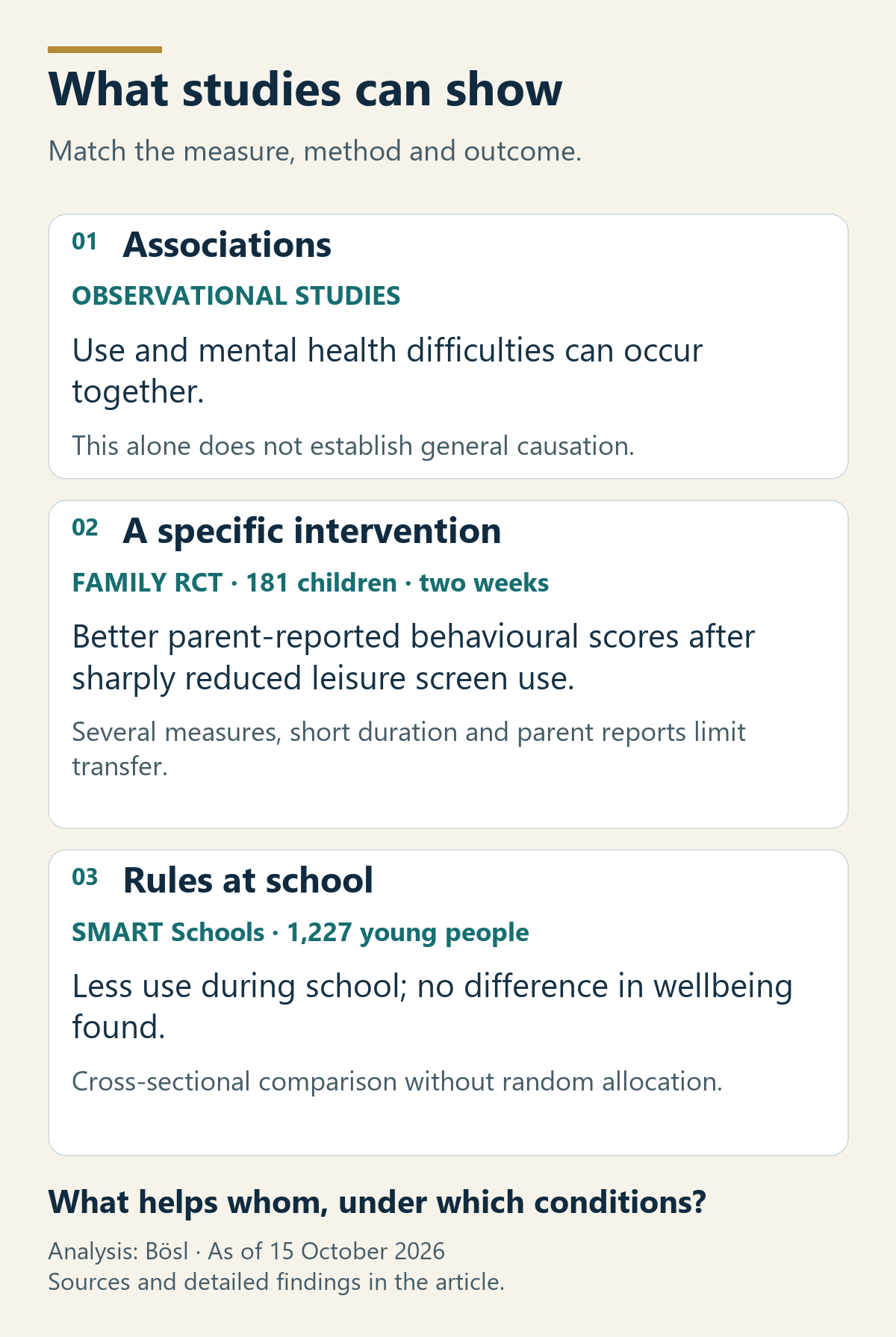
Studies can also answer different kinds of questions. A cross-sectional study identifies associations at a particular point in time. A longitudinal study follows changes and sequences over time. A randomised study can provide stronger evidence about the effect of a specific intervention. None of these methods automatically makes its findings transferable to every age group and policy measure. The following examples show why those distinctions matter.
Associations exist, and their size and direction vary
An umbrella review published online in eClinicalMedicine on 4 October 2026 brings together 121 systematic reviews covering around 2,790 distinct primary studies and more than nine million participants in total. It examines digital media from birth to age 24. Many associations are unfavourable, particularly for problematic patterns of use. However, results differ by content and life stage; age-appropriate educational content and certain active forms of use can be associated with more favourable outcomes. The certainty of the evidence is predominantly rated low or very low. The large total should therefore be read neither as blanket reassurance nor as clear proof of causation. The review covers reviews up to 2025, rather than a new October survey of nine million people. eClinicalMedicine, umbrella review and meta-analysis.
A systematic review by Fassi and colleagues, published in 2024 and corrected in 2026, includes 143 studies with approximately 1.09 million young people in total. The pooled correlation between time spent using social media and internalising mental health symptoms, such as depressive symptoms and anxiety, was approximately r = 0.12. That particular subset comprised 56 studies with around 482,000 participants. This is a small statistical association, with substantial variation between studies. It means neither that social media makes twelve per cent of users ill nor that severe individual difficulties can be ruled out. The predominantly observational data do not, on their own, establish general causation. Fassi et al., JAMA Pediatrics, current version.
In their 2024 report, the National Academies concluded that the evidence then available did not adequately support a broad causal explanation of adolescent health trends at population level. The report also describes specific risks and potential benefits. That assessment remains an important methodological reference point; newer findings need to be considered alongside it. Report summary.
One such addition is the 2025 longitudinal study by Nagata and colleagues, involving 11,876 children whose average age at baseline was just under ten. Increases in an individual's social media use relative to their own average preceded higher depressive symptoms in subsequent observation intervals. This temporal sequence strengthens the indication of a risk. Since use was not randomly assigned, other influences remain possible explanations. The finding is not a rate of newly diagnosed depression. Nagata et al., JAMA Network Open.
Another paper, published in JAMA in 2025 and involving 4,285 adolescents, examined trajectories of addictive use. High or increasing problematic patterns were associated with poorer mental health outcomes. This directs attention towards loss of control and disruption to everyday life. Here, too, the questionnaire constructs used are not individual clinical diagnoses, and the association does not identify a sole cause. Xiao et al., JAMA.
What frequently cited percentages actually mean
The 2022 WHO/HBSC survey, whose results were published in 2024, covered almost 280,000 eleven-, thirteen- and fifteen-year-olds across 44 countries and regions. Eleven per cent showed signs of problematic social media use, compared with seven per cent in 2018. These figures describe that particular international survey. They are neither a German diagnosis rate nor a measurement from 2026. At the same time, intensive users without problematic patterns reported stronger support from peers. WHO analysis.
For Germany, the 2026 DAK/UKE study provides a different perspective. Its representative subsample comprised 1,005 families with children aged ten to seventeen, surveyed between 24 September and 12 October 2025. A total of 6.6 per cent met the questionnaire criteria used for pathological social media use. The increase from the preceding wave was not statistically significant. In this report, “problematic” includes both risky and pathological patterns; these categories must not be conflated. Different instruments and samples also prevent direct comparison between the German percentages and the WHO figures. DAK/UKE, findings and methods.
For policy assessment, the implication is straightforward: every number needs an age group, a data collection period and a definition. Otherwise, a finding that deserves serious attention becomes a misleading headline.
Restrictions can help, and must be assessed specifically
A randomised family study from Denmark provides a particularly interesting finding. Eighty-nine families with 181 children and adolescents were assigned to an intervention or control group. The intervention reduced leisure screen use to no more than three hours per week per person for two weeks; smartphones and tablets were handed over. The predominantly younger children subsequently showed more favourable parent-reported behavioural scores. The difference in the overall score was 1.67 points in favour of the intervention. This supports a short-term effect of that particular package of measures. Its short duration, parent reporting and comprehensive screen reduction limit its transferability to long-term government bans on social media. Schmidt-Persson et al., JAMA Network Open, 2024.
The 2025 SMART Schools study compared 1,227 twelve- to fifteen-year-olds at 30 English schools. More restrictive rules were associated with less phone and social media use during school hours. There was no corresponding difference in total use across weekdays and weekends or in mental wellbeing. This was a cross-sectional comparison, without random allocation of schools. It establishes neither that every restriction is ineffective nor that school bans produce a health benefit. Goodyear et al., original study.
A 2026 follow-up economic analysis adds a practical perspective. In the complete subsample of 20 schools with 815 pupils, differences in quality of life and wellbeing were small. Restrictive rules might, however, reduce staff time and costs; the cost estimate was uncertain. A rule can therefore matter organisationally even when a health benefit has not been demonstrated. Perry et al., BMJ Mental Health.
A US working paper by Allcott and colleagues, revised in September 2026, examines lockable phone pouches. It links different data sources and uses staggered introduction for a quasi-experimental comparison. It finds markedly less use at school. Average test-score effects are close to zero but vary by school stage; discipline and wellbeing follow different trajectories over time. This is recent research still presented as a working paper. A particular storage solution should also not be equated with every form of school phone ban. NBER, Working Paper 35132.
What a finding can establish depends on the measure and method. Editorial analysis based on Fassi et al., Schmidt-Persson et al. and Goodyear et al.; detailed sources in the text. As of 15 October 2026. Sources: Fassi et al., Schmidt-Persson et al., Goodyear et al..
Sleep, education and young adults
A 2026 meta-analysis of daily changes in screen use and sleep includes 25 studies with 4,562 participants aged three to twenty-five. Higher-than-usual use was, on average, weakly associated with later sleep onset; other pooled sleep measures showed no statistically significant overall associations. The analysis examined screens in general and short-term changes. For regulation, this suggests considering timing and specific functions as well. JAMA Pediatrics, original abstract.
For young adults, a 2025 study of 373 eighteen- to twenty-four-year-olds is informative. Of these, 295 chose a one-week social media break; several mental health symptom scores improved. Self-selection and the absence of a randomised control group limit the conclusions. The finding supports further investigation of self-regulation, but establishes neither a lasting effect nor the effect of a government ban. Calvert et al., JAMA Network Open.
Education, too, must be judged by its effects. A randomised study published in September 2026, involving 1,012 thirteen- to twenty-nine-year-olds, examined health warnings. Some warnings were perceived as more effective than neutral messages. The outcomes measured were perceptions and intentions, rather than long-term behavioural change. Those advocating media literacy should therefore ask for measurable outcomes just as they would for a ban. Grummon et al., JAMA Health Forum.
A review of legislative approaches published in September 2026 assesses 39 empirical papers, policy analyses and other contributions. Its search ends in March 2026. It identifies both potential approaches and gaps in research on effects. The number of publications does not mean that 39 controlled studies have validated a particular ban. Nagata et al., Evidence for Social Media Legislation Strategies.
A scoping review published in Communications Psychology on 26 September 2026 examines 45 studies of social media reduction and detox interventions from 2015 to 2025. It describes substantial methodological limitations. One point is particularly relevant to policy transfer: only one included study had a mean participant age below sixteen. This does not mean that no minors were studied. It does show how cautiously findings from predominantly older samples must be applied to younger children. The review examines intervention research; it does not thereby disprove every observed health risk. Calvert et al., scoping review of the strength of detox evidence.
Online abuse and the limits of criminal law
The health debate captures only part of the problem. Protection from abuse also concerns perpetrators' behaviour, accessible help and enforcement of existing rules.
Germany's police crime prevention service explicitly explains that cyberbullying is not a standalone criminal offence, but may involve offences such as insult, threats or defamation. Violations of personality rights may also be relevant. Whether a particular act is criminal depends on the statutory requirements. The threshold of psychological harm mentioned in the discussion therefore expresses an important protective principle, rather than a universally applicable legal definition. Police crime prevention service, legal explanation.
Section 176b of Germany's Criminal Code, StGB, is among the provisions relevant to preparing the sexual abuse of children. In policy discussions, “cybergrooming” should not be used to describe any unpleasant contact. It concerns a specific set of serious abusive behaviours that prevention and law enforcement need to address directly. Current statutory text.
A minimum age for accounts addresses these issues only partly. Safe contact settings, accessible reporting channels, prompt handling and support for those affected are also necessary. The European Commission identifies precisely these elements in its guidelines on protecting minors. DSA guidelines, 14 July 2025.
Germany and the EU in October 2026
What the Federal Cabinet decided on 14 October
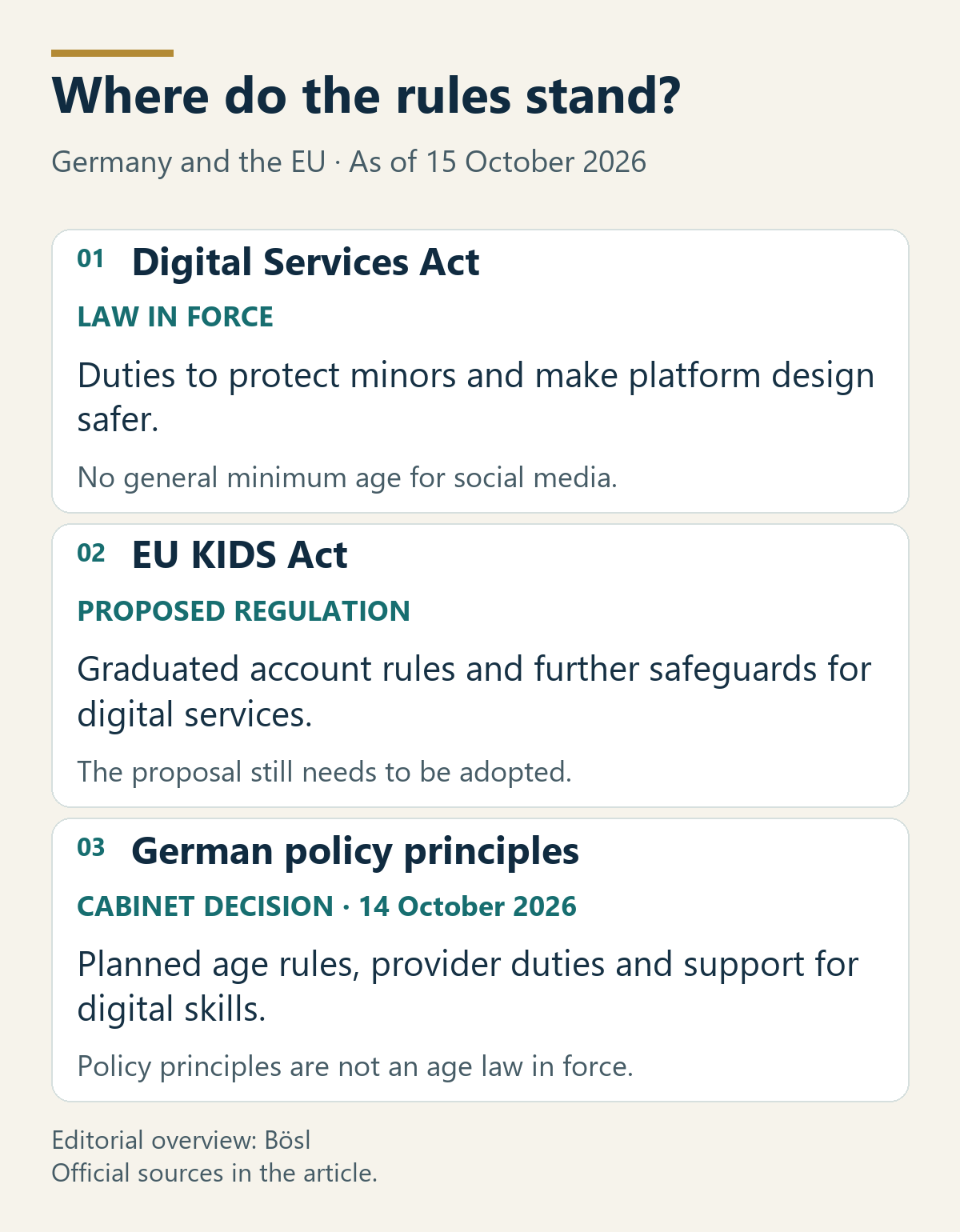
Germany's government adopted policy principles for protecting children and young people in digital media. As a national interim measure until European age rules are established, social network use would generally be prohibited below thirteen, with exemptions for demonstrably child-appropriate services. Graduated safeguards are planned for older minors. This is a concrete political mandate for implementation; it does not itself bring a general age law into force. Federal ministry press release.
The package combines age rules with providers' responsibilities and empowerment. Planned measures include media education, support for parents and a “KI-Seepferdchen”, an introductory AI skills programme for primary-school children. The “d-you” digital identity wallet planned for 2027 is intended to enable age verification with minimal data disclosure; its use is to remain voluntary. Implementation is subject to allocation of responsibilities and budget constraints. Policy principles, especially pages 2–7.
The government's stated approach therefore uses several instruments. Criticism suggesting that it relies exclusively on bans would misrepresent the package. The details, funding, responsibilities and effects need to be examined.
On 7 October, the Cabinet had already adopted a bill against online abuse, covering issues including sexualised deepfakes, cyberstalking and civil enforcement. Here, too, adopting a draft does not mean the legislative process is complete. Federal government, bill against online abuse.
Existing European duties
The Digital Services Act, DSA, is already in force. Article 28 requires covered online platforms accessible to minors to take appropriate and proportionate protective measures. Profiling-based advertising is prohibited where a platform knows with reasonable certainty that the person concerned is a minor. These duties do not additionally oblige platforms to process personal data solely to establish age. The scope and exemptions, including for certain smaller providers, still need to be considered. DSA, particularly Articles 19 and 28.
The July 2025 guidelines explain possible safeguards: private default settings, safer recommender systems, restrictions on features designed to keep users engaged and better reporting channels. The guidelines provide voluntary guidance on meeting legal obligations; following them does not automatically guarantee compliance. They are not an already applicable general EU ban on accounts. Commission explanation of the DSA guidelines.
What the proposed KIDS Act would change
The European Commission presented its proposal for the EU KIDS Act on 17 September 2026. As of 15 October, Parliament's register still lists the procedure at the preparatory stage. Parliament and the Council must first adopt the final legal act. A headline such as “The EU has banned social media for children” misrepresents this stage of the process. Commission proposal, European Parliament procedure register.
For certain social networks and video platforms with risk-related features, the proposal provides for graduated accounts:
Age
Proposed access
Under 13
No personal account; a narrowly defined option for specially designed video services would remain available through a parent or guardian's account.
13 and 14
A restricted account set up by a parent or guardian, with continuously active safeguards, a maximum of one hour's use a day and approved contacts.
15 and above
An independently held account; protection of minors remains relevant until adulthood.
The proposal also includes safe-design requirements addressing features such as endless engagement loops and unwanted contact. Further requirements also concern games, app stores and AI systems. Age rules for certain accounts therefore do not amount to a ban on every digital learning and communication service. Commission explanation of the KIDS Act, proposal, particularly Articles 6 and 7.
Law in force, the EU proposal and Germany's policy principles must be assessed separately. Editorial overview based on the official sources linked in the text. As of 15 October 2026. Sources: DSA, EU proposal, German policy principles.
International models and positions
Australia and early experience with an age rule in force
In Australia, covered platforms have been required since 10 December 2025 to take reasonable steps to prevent under-sixteens from holding accounts. Responsibility and potential penalties fall on providers, rather than children or parents. Certain services are exempt; reading publicly available material without an account is distinguished from holding a personal account. eSafety, current explanations.
The first published evaluation presents a mixed early picture. Three months after implementation, the proportion of under-sixteens in the study holding a social media account fell from 52.4 to 42.1 per cent. Use with or without an account fell from 85.9 to 81.5 per cent. The data were collected in March and published in July 2026. The regulator stresses that this early snapshot does not yet allow a robust assessment of the longer-term intended outcomes. Blocked accounts and improvements in health are different measures of success. eSafety, first evaluation of 31 July 2026.
France and the question of proportionality
On 14 August 2026, France's Conseil constitutionnel declared the general under-fifteen access rule in Article 1 of a law unconstitutional. Among other points, the decision criticises the broad coverage of services with different risk profiles, insufficient individual differentiation and inadequate safeguards in age verification. At the same time, the court recognises that protecting children can, in principle, justify access restrictions. The decision therefore establishes neither a French blanket ban currently in force nor a general prohibition of all regulation. Nor does it automatically determine the legality of the EU proposal. Decision 2026-911 DC, particularly paragraphs 10–22.
Denmark and Norway as further policy models
In September 2026, Denmark's government said it would tighten its proposal to an age threshold of fifteen. An earlier proposal allowing parental approval from thirteen therefore no longer describes the newer proposal without qualification. Stricter rules on personal screens in schools were announced at the same time. The government's statement establishes its policy direction, rather than demonstrating that legislation is already fully in force. Danish Prime Minister's Office, press conference of 10 September 2026.
In April, Norway's government announced a bill for 2026. Access would become possible from 1 January of the year in which a child turns sixteen. This differs from a strict prohibition until a child's sixteenth birthday: an entire year group would gain access together, some while still fifteen. Here, too, the cited source is a dated government plan. Norwegian government explanation of the model.
These examples show different decisions about thresholds, exemptions and responsibilities. A tally of “countries banning social media” would obscure those differences.
UN institutions connect protection with children's rights
There is no single position representing every UN body on every national age threshold. In General Comment No. 25, the UN Committee on the Rights of the Child connects protection with information, access, privacy and participation. Children's evolving capacities and independence should be considered. Restrictions must be lawful, necessary and proportionate; strong age controls for prohibited services remain expressly possible. This is an interpretation of the Convention on the Rights of the Child, rather than a newly adopted worldwide social media law. General Comment No. 25, particularly paragraphs 19–21, 59, 111 and 114.
UNICEF cautions against expecting age limits alone to provide adequate protection. Safe design, moderation, support for families and participation by young people form part of its recommended comprehensive approach. Movement towards less protected services also needs to be considered. This institutional assessment is not experimental proof that every age rule must fail. UNICEF statement, December 2025.
In its June 2026 family guide, UNESCO emphasises media and information literacy and support for parents. These complement regulation and safe design. This perspective is useful because it considers everyday life after a policy decision: rules need to be understood, supported and implemented. UNESCO, family guide for the digital age.
The policy options available
The following options can be combined. This comparison sets out their respective aims and unresolved assessment questions, drawing on the research and regulatory models described above. It is an analytical synthesis.
Instrument
Aim and potential strength
Key assessment question
Minimum age for accounts
Delay access to certain services involving risks and establish a shared expectation
Which services, exemptions and age checks are proportionate; do risks actually decrease?
Graduated youth accounts
Allow more access as independence grows
Do safeguards work under different family circumstances?
Safe design
Address risks in contact functions, recommendations and mechanisms designed to keep users engaged
How are duties assessed and enforced against providers?
School use rules
Protect lessons, concentration and face-to-face interaction
Which rules help in everyday school life, and how much staff time do they require?
Managed learning environments
Keep digital tools available for specific purposes while limiting distractions
Which devices are suitable; how are private life and equal access protected?
Media education and guidance
Develop source evaluation, self-regulation and safe behaviour
What can young people do better afterwards, and how does support remain accessible over time?
Prevention, reporting and enforcement
Prevent, stop and pursue specific abuse
Can those affected obtain help quickly, and do the responsible bodies respond effectively?
A sound decision must specify its objectives. Fewer accounts, fewer classroom disruptions, less exposure to abuse and better self-regulation are different outcomes. Each should be assessed using appropriate data. Privacy, participation and burdens on families and schools belong in the same assessment.
My commentary on protection and digital agency
Using digital tools with guidance and checking results together. AI-generated illustration with fictional people; not a photograph of the event described.
Schools need clear rules and an educational mission
I find it educationally contradictory to expect digital competence from young people while failing to give them sufficient opportunities to develop it with guidance. Independence is expected as they move into training, higher education and work. It develops through experience, practice, feedback and increasing responsibility.
For me, that does not imply an entitlement to uninterrupted personal platform use during lessons. Digital education must show how to research, check claims, work with AI outputs, protect personal data and interact with other people. That requires suitable learning environments, prepared teachers and time.
Bavaria's existing rules already provide room for this. Article 56(5) of the Bavarian Education Act, BayEUG, permits digital devices during lessons and in individual cases with the supervisor's permission. Permitted applications can be specified. For years one to seven, general authorisation outside these situations is excluded. This restricts personal use while allowing educational use. Claiming that Bavaria prohibits digital education altogether would be wrong. Current statutory text, effective from 2 October 2026.
For me, the policy task therefore lies in reliable implementation. Which skills are actually being taught? Which tools are available for that purpose? And how do we prevent an easily communicated restriction from receiving more attention than the more demanding work of creating good learning conditions?
The connection with Peter Tomaschko
In his published account of his July plenary speech, Peter Tomaschko emphasised protection in relation to personal phone use at school. His public position on schools offers a concrete starting point for discussion. I do not infer from it that he personally supports any particular general minimum age for social media. Tomaschko's account of his plenary speech.
On Monday, 19 October, I will discuss these issues with him again on a panel. I am interested in the practical connection between protection, teaching and growing independence. We should discuss that connection as concretely as the age printed in a draft law.
What I mean by Bayern-MDM
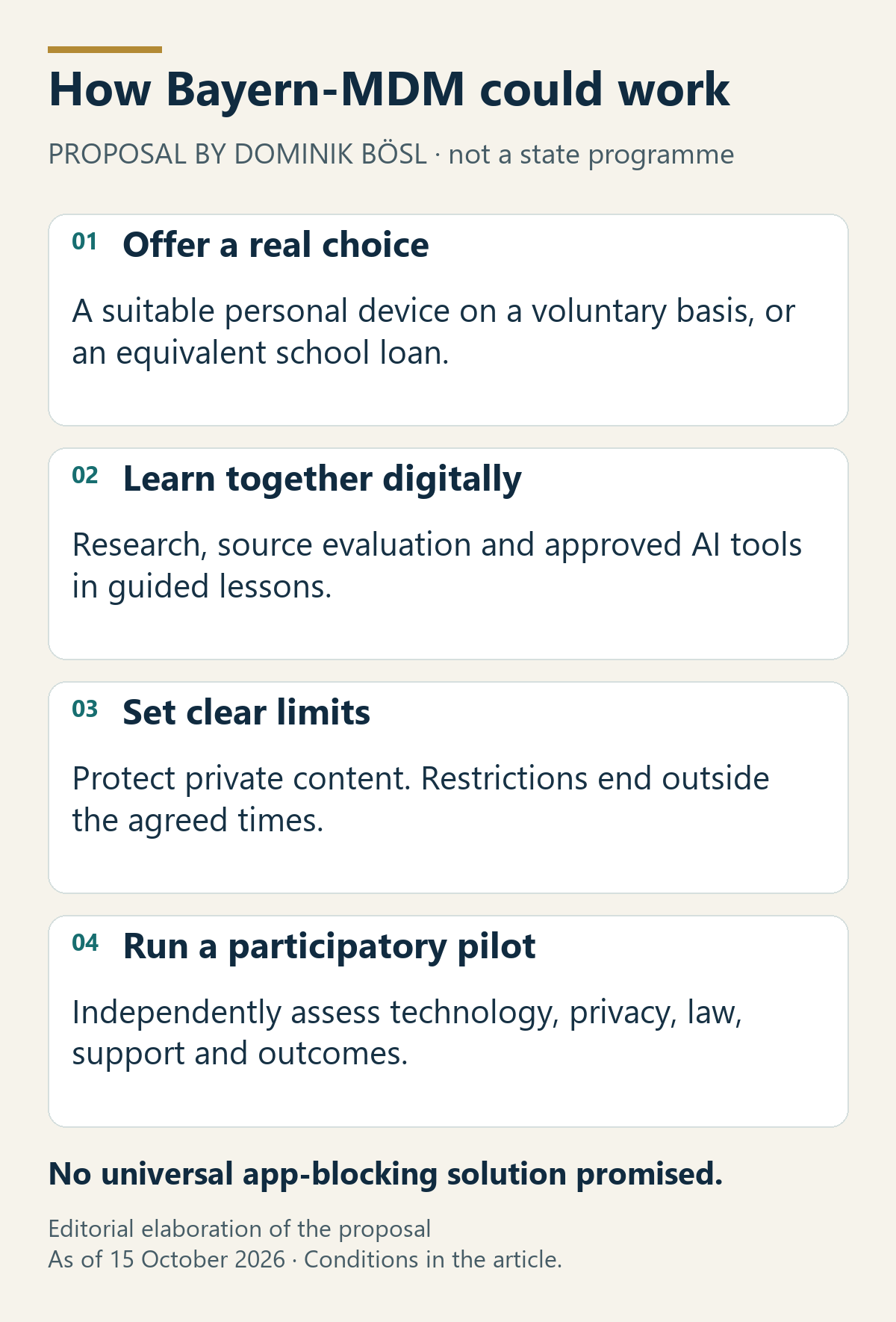
My proposal starts with an everyday school situation: during a learning period, a suitable device should be a work tool. The intended applications remain available. Distracting games and personal social media services are restricted in this mode. Outside the specified times, the school's intervention ends.
MDM stands for Mobile Device Management. Depending on the device and management method, a school can use it to provide learning applications and settings, among other things. My proposal is to develop a reliable, understandable and voluntary framework for this kind of school use in Bavaria.
It would be wrong to present device management itself as a new idea. The Bavarian Ministry of Education already describes MDM, including for pupils' personal devices. Its guidance covers consent, limited management methods, time-limited restrictions and loan devices as an alternative. Schools can make the use of personal devices conditional on enrolment; nobody has to enrol their own device. Which data are processed depends on the specific system. Ministry of Education, Mobile Device Management.
The further proposal is therefore to build on existing approaches, with understandable minimum standards, available solutions, support for schools and an independent pilot. An additional product name alone would improve nothing.
Technology imposes real limits
The idea of “install an app and all private distractions are blocked at school” cannot automatically be implemented across different personal phones. A central distinction is between a fully managed school device and a personal device with a limited school-managed area.
With Android work profiles, personal apps and data are generally kept separate from the managed area. The organisation manages the work area. This does not imply blanket control over every personal application. Google, Android Work Profile.
Apple's User Enrollment for personal devices likewise permits only a limited set of management functions. Its documentation separates school- or organisation-managed data and accounts from the personal account; other enrolment methods allow more extensive intervention. Device type, operating system and management mode therefore need to be assessed before making a commitment. Apple, User Enrollment and device management.
Bayern-MDM would need to explain these differences openly. For some requirements, school devices or dedicated classroom tools might be the better solution. Technical compatibility, reliability and the effort involved in switching between school and personal use belong in a pilot. The proposal is therefore a development task whose feasibility and effects can be tested.
Voluntary participation needs a workable alternative
During the discussion, I suggested that pupils who do not participate should put their personal phones away during school hours. A developed approach needs one further condition: choosing against school management of a personal device must not worsen access to digital lessons. A suitable loan device or an equivalent school-provided solution therefore belongs in the model.
This is also a question of genuine choice. The European Data Protection Board points out that, where there is a power imbalance, particularly in relation to public authorities, the freedom of consent requires especially careful assessment. Agreement to device management does not automatically settle every question about the legal basis for each processing operation. EDPB, Guidelines 05/2020 on consent.
I consider the following requirements essential for a pilot:
A clear educational purpose. Management covers what is needed for the agreed lessons. Private messages, photographs and contacts must not become subject to school content monitoring.
Visible, limited operating periods. Those affected can see when restrictions apply. Personal use outside these periods remains protected; continuous location tracking is not the objective.
Access without a personally owned managed device. Anyone without a suitable phone, or who chooses not to participate, receives a workable school alternative.
Security and support. Responsibilities, permissions, faults, deletion and leaving the scheme are clarified before it starts. Teachers need reliable support.
Participation and independent evaluation. Pupils, parents, teachers, school authorities and data protection specialists help design the pilot. Concentration, skills, workload and unintended consequences are assessed.
These requirements are my elaboration of the proposal. They do not replace the technical and legal assessment of the actual model selected.
Bayern-MDM as proposed by Dominik Bösl, with editorial elaboration: equal access, limited intervention and an independent pilot. This is not an established state programme; technical and legal assessment is still required.
From primary school to young adulthood
I want the debate to cover the whole developmental journey. At primary school, children can practise assessing information, recognising advertising, protecting personal data and seeking help with unpleasant contacts in protected learning environments. This does not require an unrestricted personal account on a platform involving risks.
In early adolescence, guidance that respects privacy while remaining available becomes more important. For roughly ten- to fourteen-year-olds, the American Psychological Association recommends viewing together, discussion and coaching; independence can increase as skills develop. This professional guidance does not establish a universally optimal statutory age threshold. APA, Health advisory on social media use in adolescence.
In later adolescence, greater independence should be accompanied by demonstrable competence. Rules must remain understandable and must not leave the transition to personal responsibility to chance. Young adults still need transparent services, good information and accessible support. They are adults; rules for minors cannot be transferred to them unchanged.
These four life stages offer guidance for education and policy. They do not imply that everyone reaches the same level of maturity on the same birthday.
Digital agency develops through guidance, practice and growing independence. AI-generated illustration; the life stages provide educational guidance.
Provider duties and education need lasting support
Education must not mean leaving families to struggle alone against the design of large platforms. I consider enforceable, verifiable duties for providers necessary. These include safe defaults, understandable recommendations, restricted contact options and functioning complaint channels. Whether a proposed rule achieves these aims depends on its design and enforcement.
At the same time, a rule on paper is insufficient to develop digital agency. Schools need time and support, families need understandable information, and those affected need help. Young people should participate in shaping the rules. To me, participatory technology dialogue means taking them seriously as people affected by technology and as its future shapers.
I will therefore bring a concrete proposal to the next panel: expand existing opportunities for digital education, pilot a voluntary school mode under clear conditions, and examine its effects openly. Protective rules deserve the same care. Ultimately, young people should be able to act more safely, recognise risks more effectively and exercise greater agency over the technology shaping their everyday lives.
Frequently asked questions about social media regulation
Has the EU already banned social media for children?
As of 15 October 2026, the KIDS Act is a proposed regulation. The parliamentary procedure is at the preparatory stage; the final text still needs to be adopted. The Commission's proposal is not a general ban already in force. EU procedure register.
What age groups does the KIDS Act provide for?
For covered social networks and video platforms, the proposal generally provides for no personal accounts below thirteen, restricted parent-set-up accounts for thirteen- and fourteen-year-olds, and independent accounts from fifteen. Safe-design requirements and specific exceptions also apply. Commission explanation.
What did Germany's government decide on 14 October?
The Cabinet adopted policy principles covering planned age rules, platform responsibility and skills development. A national interim rule is planned for under-thirteens, with exemptions for child-appropriate services. Policy principles do not themselves constitute an age law immediately in force. Official press release.
Does research show that bans are ineffective?
The research presented here does not support such a blanket conclusion. Family interventions, school rules and government account-age restrictions are different measures with different outcomes. Less use also does not automatically demonstrate a lasting improvement in health. Review of legislative approaches.
Is cyberbullying a criminal offence?
In Germany, cyberbullying describes different behaviours and is not a standalone criminal offence. Individual acts may constitute offences such as insult, threats or defamation and infringe other rights. The possible legal consequences depend on the particular case. Police crime prevention service.
Does Bavaria ban digital devices in lessons?
Devices are permitted during lessons and in individual cases with the supervisor's permission. For years one to seven, general authorisation outside these situations is restricted. The rules distinguish guided use from personal use. Article 56(5), BayEUG.
What does Bayern-MDM mean?
Bayern-MDM is my proposal for a voluntary school mode on suitable devices: learning tools remain available, distractions are limited, and school intervention ends outside the agreed times. MDM already exists in Bavaria. The proposal concerns a reliable framework, practical support and a pilot. Existing Bavarian MDM guidance.
Could a school use it to block every personal app?
That depends on the device and management mode. Android personal work profiles and Apple's User Enrollment limit access to private areas. A universal blocking app for every personal phone is therefore not guaranteed. Google documentation, Apple documentation.
Would children without a managed personal device be excluded from digital learning?
My proposal requires an equivalent school-provided alternative. Requiring a personal device to be put away and ensuring continued participation in digital lessons are compatible requirements. Consent, access and actual implementation must be assessed together as part of the model.
Is education an alternative to all regulation?
I support combining education, protection and verifiable provider responsibility. UNICEF likewise recommends a comprehensive approach and cautions against expecting age limits alone to provide sufficient protection. Media education must be assessed for its practical effects just as restrictions must. UNICEF statement.
Related reading added on 18 October 2026: Digital agency matters at every stage of life. In AI After 60, I apply the ideas of understandable explanations, first-hand experience and participation to older adults. Support needs to suit each person’s circumstances.
Robotic Governance: A Regulatory Framework for Autonomous Machines
Humanoid robots are walking through warehouses. Autonomous vehicles make evasive decisions in milliseconds. Surgical assistance systems perform procedures without a surgeon directly at the instrument. None of these are future scenarios - they describe the operational reality of 2024. The EU AI Act is in force, and covers AI in products and safety functions. The physically acting machine that moves, lifts, touches, protects and can injure people also requires machinery law, technical standards and operational responsibility. This broader need for a governance framework is the starting point for Robotic Governance - a concept anchored in academic research since 2016 and more urgent today than it has ever been.
What Robotic Governance Means
I developed the concept through my doctoral research at the Technical University of Munich, supervised by Klaus Mainzer. One foundational publication is Technology Governance, which Martina Bode and I published at IEEE EmergiTech in 2016. An extended chapter followed in a Springer volume on Robotic Governance. Both publications established the concept academically and defined its scope.
Robotic Governance refers to the regulatory and ethical framework for
the responsible research, development, implementation, and management
of increasingly intelligent and autonomously acting machines. The approach
is holistic: it involves research, society, politics, industry, religious
institutions, and trade unions, aiming for consensus through discourse
ethics - not one-sided top-down regulation.


Source: https://en.wikipedia.org/wiki/Robotic_governance
Robotic Governance is not a subdivision of Corporate Governance, IT Governance, or Technology Governance. Corporate Governance deals with organizational management, board accountability, and shareholder obligations. IT Governance addresses the strategic oversight of information systems. Technology Governance handles the broader societal embedding of technology.
Robotic Governance is both more specific and broader: it explicitly addresses systems that act physically in the world, that exert force, that move through space, and that come into direct contact with human bodies. A chatbot that delivers incorrect information is a problem. An autonomous transport system that makes the wrong decision injures people. That distinction is what justifies a dedicated governance framework. I discuss my view of how these systems evolve in my retrospective on the four robotic revolutions.
The full Wikipedia article on the concept is available at: en.wikipedia.org/wiki/Robotic_governance. It also describes the Robot Manifesto as a product of the discourse ethics approach - behavioral codes and procedural norms such as ethics commissions, designed to resolve conflicts case by case before political or regulatory intervention becomes necessary.
The Gap in the AI Act
The EU AI Act, which entered into force in 2024, is a serious first attempt to bring artificial intelligence under regulatory control. It classifies AI systems by risk level, mandates transparency requirements, and defines prohibited applications. That is necessary and correct.
But the AI Act regulates AI as a software system. A language model, an image classifier, a recommendation algorithm - those are its typical objects. Robots are more. An industrial robot weighing 200 kilograms, moving components with 1,500 newtons of gripping force, is not a software system. It is a mechatronic system with actuators, sensors, real-time control loops, and physical effects in the world. The AI Act covers the embedded intelligence in that system - but not the machine itself.
What the AI Act does not regulate:
Movement and physical interaction: How an autonomous system exerts force on people or objects, which safety distances apply, how emergency stops are implemented - these fall under machinery directives, ISO 10218, and sector-specific standards, not the AI Act.
Hardware supply chains: Who bears responsibility when a robot assembled from 47 components supplied by 23 vendors fails in its AI-guided function? The AI Act does not answer this.
Human-machine interaction in safety-critical environments: How a surgical assistance system communicates with a surgeon, how a collaborative robot responds to human proximity during a production shift - these require independent regulation.
Autonomous systems in public spaces: Delivery robots on sidewalks, humanoid care assistants in nursing homes, autonomous security robots in shopping centers - all operate in a regulatory grey zone.
Lifecycle responsibility and recall: What happens when an autonomous system shows different behavior after an update to its AI model? Who is liable? The EU's revised Product Liability Directive of 2024 was not primarily conceived for learning, evolving systems, and the interface remains unresolved.
The consequence is concrete: a company developing an autonomous industrial robot with integrated AI today must simultaneously comply with the AI Act, Machinery Directive 2006/42/EC, the new Machinery Regulation (EU) 2023/1230, relevant ISO standards, and sector-specific requirements - without anyone having assembled these pieces into a coherent framework. The compliance effort is real, the overlaps are complex, and the room for interpretation is wide. That is precisely the task of Robotic Governance: not to create yet another regulatory instrument, but to bring the existing building blocks into a coherent structure.
The Five Pillars of Robotic Governance
Robotic Governance is not a single instrument. It is a framework that brings together different levels of governance. Five pillars form the structure - developed and described in the original 2016 publications and extended in academic discourse since then.
1. Legal Framework
Laws and regulations provide the binding foundation. The EU AI Act is one building block, not a complete structure. What is needed: clear liability rules for autonomous systems. When an AI-controlled robot arm injures a worker in production, the liability question is open in many jurisdictions today. Who bears responsibility - the robot manufacturer, the system integrator, the operating company, or the developer of the AI model? The EU's revised Product Liability Directive addresses some aspects, and expressly addresses software, AI and products that continue to learn after being placed on the market. National implementation and transition rules must still be considered.
Additionally, the legal personhood of machines in specific contexts needs clarification: an autonomous vehicle acting as a contracting party, or a care robot making independent decisions about medication administration in a nursing home - clear legal categories for these situations are still missing. The EU Machinery Regulation (EU) 2023/1230 is a step forward, but it was developed without explicit coordination with the AI Act. That gap between the two instruments is the real structural problem, and it will only widen as systems become more capable.
2. Ethical Guardrails
Legal minimum requirements are not sufficient when machines make morally charged decisions. Who has priority: the passenger in an autonomous vehicle or the pedestrian? How does a robot's self-protection function weigh against a nearby human? How does a humanoid care robot evaluate competing needs of a patient with dementia?
These questions cannot be fully codified in standards. Ethical guardrails must therefore be integrated into development processes as explicit design requirements - not as a retrospective check, but as input to system architecture. The IEEE 7000 Standard for ethically aligned system design offers an applicable framework: it defines methods for identifying ethical requirements, weighting competing values, and documenting ethical design decisions in a form that survives an audit.
3. Technical Standards
Standards translate abstract requirements into concrete engineering specifications. Without them, governance stays abstract. For Robotic Governance, the most relevant include:
ISO 10218-1: Safety requirements for industrial robots. Part 1 concerns the robot itself; Part 2 concerns integration and the safety of the complete robot application and cell. Protective zones and safety distances therefore require consideration of the application context. For collaborative robotics, ISO/TS 15066 extends this framework with specific requirements for human-robot collaboration.
VDA 5050: Interface standard for autonomous mobile systems in industry and logistics. It enables cross-manufacturer communication between vehicles and control systems - making it a technical governance measure that can support interoperability and reduce vendor dependence. A company implementing VDA 5050 creates the foundation for transparent, auditable system control.
IEEE 7000: Ethically aligned system design as a standard - a methodological basis for integrating ethical requirements into development processes, from requirements specification to acceptance testing.
Standards are not bureaucratic overhead. They are the language in which governance becomes operational. A company able to demonstrate conformity of its robot applications with the relevant ISO 10218 requirements and operating VDA 5050 can demonstrate to customers, regulators, and insurers what its system can do - and what it cannot.
4. Economic Incentives
Regulation alone is not enough. When compliance costs more than the calculated risk of an incident, compliance is avoided - particularly in small and medium-sized enterprises where resources are constrained. Robotic Governance therefore needs incentive structures that make compliance economically attractive.
Multiple mechanisms can achieve this: insurance models that reward demonstrably safer systems with lower premiums; certification pathways that facilitate market access rather than blocking it; public procurement rules that prefer governance-compliant systems. A company with reliable evidence that its robot applications meet the relevant ISO 10218 requirements, operating VDA 5050, and with IEEE 7000 integrated into its development process should have measurable advantages in public tenders. That would be governance with economic effect - not just a compliance exercise.
5. Societal Dialogue
Technical systems operating in care facilities, schools, public spaces, and production environments require social legitimacy. This is not generated by press releases, but through structured dialogue. That means: citizen participation in municipal robotics projects before the first systems are deployed, not after; union involvement in the introduction of autonomous factory systems before the decision is made, not after; open, empirically grounded debate about robots in sensitive contexts such as childcare, elderly care, or corrections facilities.
Robotic Governance without societal dialogue is technocracy. With structured dialogue, governance becomes a durable social contract - one that holds even when a system fails and the public debate begins. Because in that moment, what gets evaluated is not just the system, but the process through which it entered the world. I describe how businesses discuss these questions of responsibility in my EDAY 2026 retrospective.
Robotic Natives and Generation R
All five pillars address current actors: companies, regulators, engineers, ethicists, union representatives. But governance is not a snapshot. It must also be designed for the people who will grow up with these systems - and who in twenty years will make the decisions about what robots are permitted to do.
That is the context in which the concept of Generation R was introduced - first at the Gartner CIO Summit in 2013, then in a peer-reviewed publication at IEEE EmergiTech 2016. Generation R, also called the "Robotics Generation," is the first generation growing up with robots as part of daily life: household robots, autonomous vehicles as standard transport, robotic toys as a first technological companion, and collaborative systems in the workplaces of their parents.
Members of this generation are called Robotic Natives - by analogy with the Digital Natives of Generations Y and Z. The difference is substantial: Digital Natives grew up with screens and networks, with information systems that process data. Robotic Natives grow up with systems that act physically, that occupy space, that exert force, and that make decisions with physical consequences in the real world. The concept of the Robotic Native is documented in the academic literature originating from this research line. This different relationship with technology creates different expectations about how it should be governed.
For Robotic Governance, this has concrete implications:
Education: Technological literacy in working with autonomous systems must be anchored in school curricula - not as an elective, but as foundational education. A person who does not understand how an autonomous system makes decisions, what data it uses, and what error types it has cannot evaluate or challenge those decisions. That is a democratic question, not only a technical one.
Work: Job profiles are changing. Not because robots "take all the jobs" - that claim is empirically thin and historically unreliable. But because new roles are emerging that require different qualifications: robot supervision during production shifts, system integration across heterogeneous fleets, governance compliance as a dedicated function, AI-assisted quality assurance. Education and training systems are not yet aligned with this reality.
Society: Generation R will evaluate governance questions differently from today's decision-makers. People who grew up with autonomous systems ask different questions: not primarily "is it safe?" - that baseline is assumed -, but "who is specifically responsible when it fails?" and "how can I as an affected person exercise influence?" That is a more mature and more demanding governance posture - and it must be built into the system before that generation reaches decision-making positions.
What Companies Should Do Now
Robotic Governance is not a topic for 2030. Anyone developing, procuring, or operating autonomous systems today is already acting in a regulatory environment that is consolidating rapidly. The Machinery Regulation (EU) 2023/1230 applies from 2027. The AI Act is being applied in phases, with rules on prohibited AI practices and AI literacy applying from 2025 and the main high-risk requirements following later. Five measures that are implementable now:
Conduct a governance inventory: Which autonomous systems are in operation or in procurement? Which fall under the AI Act, which under the Machinery Regulation, which under ISO 10218? Which fall into high-risk categories? These overlaps must be mapped before the first audit arrives - not after. A company that cannot answer these questions has a compliance gap, regardless of how good its systems technically are.
Make VDA 5050 a binding technical standard: For companies operating multiple AGV or AMR systems from different manufacturers, VDA 5050 is no longer optional - it is an operational necessity. Companies still running proprietary interfaces are building vendor lock-in today that they will spend significant effort unwinding in three years. They are also foregoing the transparency that auditable system control requires.
Set ISO 10218 as the safety baseline:ISO 10218-1 defines the safety standard for industrial robots. It should serve as a reference not only for new purchases but also for existing systems in the installed base. A gap analysis against ISO 10218 is the first step toward defensible safety documentation.
Define internal governance roles: Who in your organization carries responsibility for the governance of autonomous systems? If the answer is "legal will handle it" or "that's IT security's domain," that is a structural gap. Robotic Governance requires technical, legal, and ethical competence in one role - or in a structured, cross-functional body with clear decision authority.
Adopt IEEE 7000 as a development methodology: The IEEE 7000 Standard for ethically aligned system design is not a philosophical document - it is an applicable methodology. It defines how ethical requirements are formulated in specifications, implemented in system designs, and verified in acceptance testing. That is governance you can document and audit.
No company needs to implement all five points simultaneously. But every company operating autonomous systems should know exactly where it stands on each one - and be able to put that assessment in writing.
Conclusion
Robotic Governance is not an academic construct waiting for better conditions. It is a direct response to a concrete governance gap: autonomous machines act physically in the world, but the regulatory framework was built for software systems. That discrepancy grows with every new robot generation - with every new application domain, with every humanoid system entering a new societal context.
The EU AI Act is an important step - but it is not sufficient. It also covers product-related AI and safety functions. Machinery law and technical standards likewise address control systems and safe applications. The practical task is to connect these requirements. Between these lies a space that needs structure. Robotic Governance describes and organizes that space. And it is not a brake on innovation - it is innovation's prerequisite: a company that cannot explain how its system decides, who is liable, and which standards apply will not be permitted to operate that system in safety-critical applications.
Those who do not start understanding this framework and implementing it internally will be unprepared at the next regulatory cycle. Generation R will demand accountability, not statements of intent. Auditors will want documentation, not slide decks. And the first serious lawsuit against an autonomous system will ask whether the company had an internal governance process - or just a robot.
The Robotic & AI Governance Foundation works to close these gaps - through concrete frameworks, academic publications, and the goal of establishing Robotic Governance as an independent field that brings together technology, law, and society.
Related reading added on 18 October 2026: My article AI After 60 shows how understandable explanations and participation connect in everyday life. A question at an Augsburg event for older adults becomes a case for trying technology, checking its results and having a say in society.